241 posters, 10 topics, 7 sessions, 899 authors, 296 institutions
ePostersLive by SciGen Technologies S.A. All rights reserved.
The AAPS 103rd Annual Meeting 2025
May 24-27, 2025 | Austin, Texas

D18
RNA-Guided Molecular Diagnosis Of Cleft Lip And Palate Malformation.
Part of Topic
Basic Science Research
RNA-Guided Molecular Diagnosis Of Cleft Lip And Palate Malformation
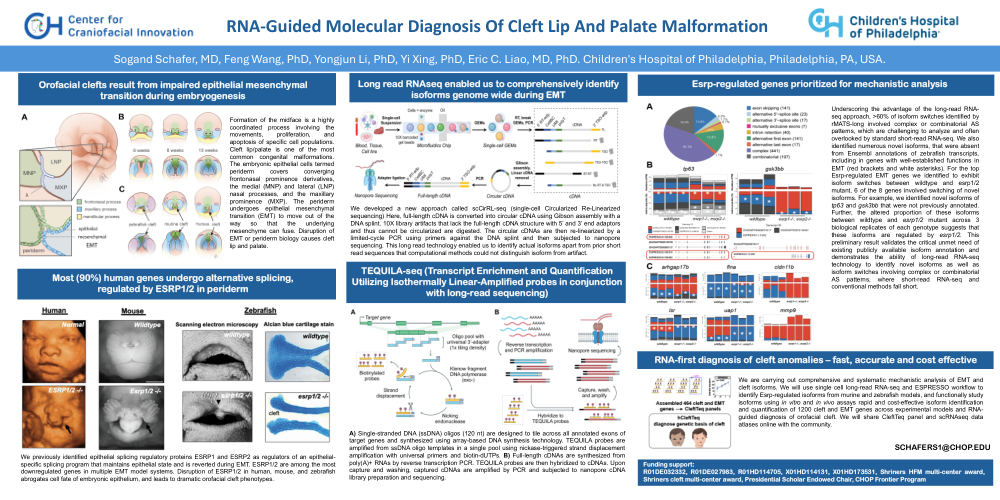
Formation of the midface is a highly coordinated process involving the movements, proliferation, and apoptosis of specific cell populations. Cleft lip/palate is one of the most common congenital malformations. The embryonic epithelial cells termed periderm covers converging frontonasal prominence derivatives, the medial (MNP) and lateral (LNP) nasal processes, and the maxillary prominence (MXP). The periderm undergoes epithelial mesenchymal transition (EMT) to move out of the way so that the underlying mesenchyme can fuse. Disruption of EMT or periderm biology causes cleft lip and palate.
We previously identified epithelial splicing regulatory proteins ESRP1 and ESRP2 as regulators of an epithelial-specific splicing program that maintains epithelial state and is reverted during EMT. ESRP1/2 are among the most downregulated genes in multiple EMT model systems. Disruption of ESRP1/2 in human, mouse, and zebrafish abrogates cell fate of embryonic epithelium, and leads to dramatic orofacial cleft phenotypes.
We developed a new approach called scCirRL-seq (single-cell Circularized Re-Linearized sequencing) Here, full-length cDNA is converted into circular cDNA using Gibson assembly with a DNA splint. 10X library artifacts that lack the full-length cDNA structure with 5’ and 3’ end adaptors and thus cannot be circularized are digested. The circular cDNAs are then re-linearized by a limited-cycle PCR using primers against the DNA splint and then subjected to nanopore sequencing. This long read technology enabled us to identify actual isoforms apart from prior short read sequences that computational methods could not distinguish isoform from artifact.
Underscoring the advantage of the long-read RNA-seq approach, >60% of isoform switches identified by rMATS-long involved complex or combinatorial AS patterns, which are challenging to analyze and often overlooked by standard short-read RNA-seq. We also identified numerous novel isoforms, that were absent from Ensembl annotations of zebrafish transcripts, including in genes with well-established functions in EMT (red brackets and white asterisks). For the top Esrp-regulated EMT genes we identified to exhibit isoform switches between wildtype and esrp1/2 mutant, 6 of the 8 genes involved switching of novel isoforms. For example, we identified novel isoforms of tp63 and gsk3bb that were not previously annotated. Further, the altered proportion of these isoforms between wildtype and esrp1/2 mutant across 3 biological replicates of each genotype suggests that these isoforms are regulated by esrp1/2. This preliminary result validates the critical unmet need of existing publicly available isoform annotation and demonstrates the ability of long-read RNA-seq technology to identify novel isoforms as well as isoform switches involving complex or combinatorial AS patterns, where short-read RNA-seq and conventional methods fall short.
We are carrying out comprehensive and systematic mechanistic analysis of EMT and cleft isoforms. We will use single cell long-read RNA-seq and ESPRESSO workflow to identify Esrp-regulated isoforms from murine and zebrafish models, and functionally study isoforms using in vitro and in vivoassays rapid and cost-effective isoform identification and quantification of 1200 cleft and EMT genes across experimental models and RNA-guided diagnosis of orofacial cleft. We will share CleftTeqpanel and scRNAseq data atlases online with the community.