203 posters, 14 topics, 5 sessions, 817 authors, 256 institutions
ePostersLive by SciGen Technologies S.A. All rights reserved.
The AAPS 102nd Annual Meeting
May 18-21, 2024 | The Westin Copley Place, Boston, MA

P43
Outcomes Of Free Tissue Transfer In Lower Extremity Soft Tissue Sarcoma Reconstruction: An Analysis At A Quaternary Cancer Center
Poster Presenter
Part of Topic
Hand / Craniofacial
Background
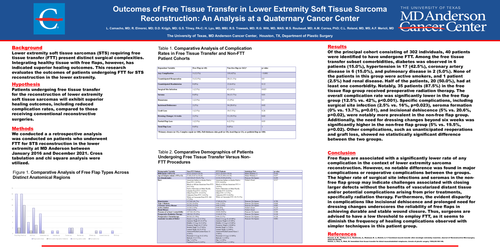
Lower extremity soft tissue sarcomas (STS) requiring free tissue transfer (FTT) present distinct surgical complexities. Integrating healthy tissue with free flaps, however, has indicated superior healing outcomes. This research evaluates the outcomes of patients undergoing FTT for STS reconstruction in the lower extremity.
Hypothesis
Patients undergoing free tissue transfer for the reconstruction of lower extremity soft tissue sarcomas will exhibit superior healing outcomes, including reduced complication rates, compared to those receiving conventional reconstructive
surgeries.
Methods
We conducted a a retrospective analysis was conducted on patients who underwent FTT for STS reconstruction in the lower extremity at MD Anderson between January 2016 and December 2021. Cross tabulation and chi square analysis were utilized.
Results
Of the principal cohort consisting of 302 individuals, 40 patients were identified to have undergone FTT. Among the free tissue transfer subset comorbidities, diabetes was observed in 6 patients (15.0%), hypertension in 17 (42.5%), coronary artery disease in 6 (15.0%), and pulmonary disease in 2 (5.0%). None of the patients in this group were active smokers, and 1 patient (2.5%) had renal disease. Half of the patients, 20 (50.0%), had at least one comorbidity. Notably, 35 patients (87.5%) in the free tissue flap group received preoperative radiation therapy. The overall complication rate was significantly lower in the free flap group (12.5% vs. 42%, p<0.001). Specific complications, including surgical site infection (2.5% vs. 16%, p=0.023), seroma formation (0% vs. 13.7%, p=0.01), and incisional dehiscence (5% vs. 20.6%, p=0.02), were notably more prevalent in the non-free flap group. Additionally, the need for dressing changes beyond six weeks was significantly higher in the non-free flap group (5% vs. 19.5%, p=0.02). Other complications, such as unanticipated reoperations and graft loss, showed no statistically significant difference between the two groups.
Conclusion
Free flaps are associated with a significantly lower rate of any complication in the context of lower extremity sarcoma reconstruction. However, no notable difference was found in major complications or reoperative complications between the groups. The higher rate of surgical site infections and seromas in the non- free flap group may indicate challenges associated with closing larger defects without the benefits of vascularized distant tissue and/or potential complications arising from prior treatments, specifically radiation therapy. Furthermore, the evident disparity in complications like incisional dehiscence and prolonged need for dressing changes underscores the reliability of free flaps in achieving durable and stable wound closure. Thus, surgeons are advised to have a low threshold to employ FTT, as it seems to diminish the frequency of healing complications observed with
simpler techniques in this patient group.