203 posters, 14 topics, 5 sessions, 817 authors, 256 institutions
ePostersLive by SciGen Technologies S.A. All rights reserved.
The AAPS 102nd Annual Meeting
May 18-21, 2024 | The Westin Copley Place, Boston, MA

P42
Dose-dependent Response In Birth Prevalence Of Limb Reduction Defects Related To Quantity Ofmaternal Peripartum Smoking
Poster Presenter
Authors
Affiliations
Part of Topic
Hand / Craniofacial
ØLimb reduction defects (LRDs) are congenital anomalies which occur when there is a shortening or absence of an upper or lower limb which occurs during limb bud development in a fetus.
ØLimb development begins around the 6th week of gestational age, with the upper limb appearing slightly before the lower limb [1] with growth of upper and lower limbs continuing through the second trimester.
ØIn the US, LRDs are one of the most common major birth defects and occur in approximately 1 out of every 1943 births [2].
ØLimb Reduction Defects (LRDs) are congenital anomalies shown to be associated with maternal peripartum tobacco use.
ØHere we investigate dose-dependence of limb reduction defects related to quantity of maternal peripartum smoking in relevant gestational periods.
ØPopulation-based data was extracted using the U.S. Natality database, which included maternal demographics, peripartum cigarette use, and presence of congenital defects. [3]
ØData for 22.8 million US births from 2016 to 2021 was examined and exported in aggregate, filtered by the presence of congenital anomaly of ‘Limb Reduction Defect’ and liveborn infants without limb reduction defects.
ØOdds Ratios with confidence intervals were calculated to compare birth records with Limb Reduction Defects to birth records without.
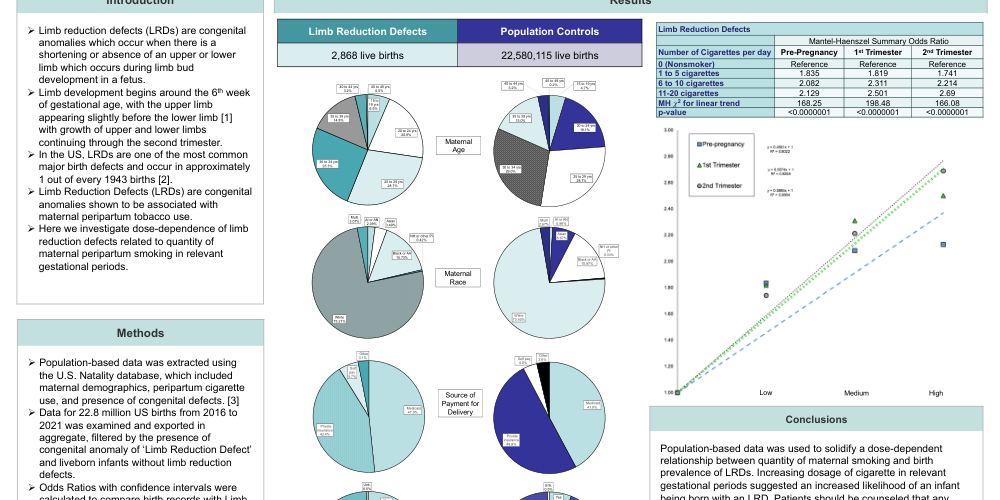
ØMantel-Haenszel (MH) Chi-squared test for linear trend assessed dose-dependence through comparison of likelihood of LRD at three doses of maternal smoking, 1-5, 6-10 and 11-20 cigarettes daily.
Population-based data was used to solidify a dose-dependent relationship between quantity of maternal smoking and birth prevalence of LRDs. Increasing dosage of cigarette in relevant gestational periods suggested an increased likelihood of an infant being born with an LRD. Patients should be counseled that any reduction in maternal smoking can decrease risk of LRDs.