203 posters, 14 topics, 5 sessions, 817 authors, 256 institutions
ePostersLive by SciGen Technologies S.A. All rights reserved.
The AAPS 102nd Annual Meeting
May 18-21, 2024 | The Westin Copley Place, Boston, MA

P40
Evolution Of Craniosynostosis Care At A Single Institution Over An 11 Year Period
Poster Presenter
Part of Topic
Hand / Craniofacial
Evolution of Craniosynostosis Care at a Single Institution Over an 11 Year Period
INTRODUCTION
•Since the inception of craniofacial surgery, the surgical correction of craniosynostosis has evolved in a cyclical nature.
•
•Techniques once abandoned for their morbidity and mortality have resurfaced, albeit modernized and refined. Newer techniques involving less invasive operations have been developed.
AIM
•This study provides an overview on the history of craniosynostosis and evolution of its surgical correction.
•
•Document the evolution of craniosynostosis care over an 11-year period at one academic institution and record the outcomes associated with the implementation of evidence-based surgical techniques and protocols.
METHODS
•Patient demographics, operative details, and postoperative courses were collected for patients who received surgical cranial vault remodeling for craniosynostosis at the authors’ institution.
•Primary outcomes include estimated blood loss (EBL), blood replacement volumes, length of procedure, length of intensive care unit (ICU) stay, and morphine milliequivalents (MME) given during inpatient stay.
•Chi square tests and independent t-tests were utilized to determine significance (0.05).
•
RESULTS
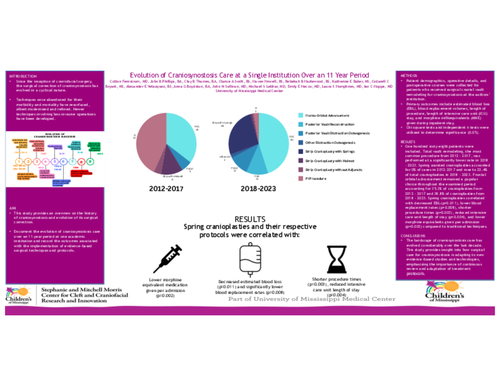
•One hundred sixty-eight patients were included. Total vault remodeling, the most common procedure from 2012 – 2017, was performed at a significantly lower rate in 2018 - 2023. Spring assisted cranioplasties accounted for 0% of cases in 2012-2017 and rose to 22.4% of total cranioplasties in 2018 - 2023. Frontal orbital advancement remained a popular choice throughout the examined period accounting for 35.3% of cranioplasties from 2012 - 2017 and 38.8% of cranioplasties from 2018 - 2023. Spring cranioplasties correlated with decreased EBL (p=0.011), lower blood replacement rates (p=0.008), shorter procedure times (p=0.003), reduced intensive care unit length of stay (p=0.004), and lower morphine equivalents given per admission (p=0.002) compared to traditional techniques.
CONCLUSIONS
•The landscape of craniosynostosis care has evolved considerably over the last decade. This study provides insight into how surgical care for craniosynostosis is adapting to new evidence-based studies and technologies, emphasizing the importance of continuous review and adaptation of treatment protocols.