203 posters, 14 topics, 5 sessions, 817 authors, 256 institutions
ePostersLive by SciGen Technologies S.A. All rights reserved.
The AAPS 102nd Annual Meeting
May 18-21, 2024 | The Westin Copley Place, Boston, MA

P37
Reconstructing Soft Tissue Sarcoma Patients: Tumor Bed Excision Defects Are Deceiving And Result In Higher Reoperation Rates
Part of Topic
Hand / Craniofacial
Reconstructing Soft Tissue Sarcoma Patients: Tumor Bed Excision Defects are Deceiving and Result in Higher Reoperation Rates
Rami Elmorsi, MD*; L. Camacho, MD; D.D. Krijgh, MD; G.S. Tilney, PA-C; H. Lyu, MD, MBI; R.S. Traweek, MD; R.G. Witt, MD, MAS; M.S. Roubaud, MD; A.M. Correa, PhD; C.L. Roland, MD, MS; A.F. Mericli, MD
*University of Texas MD Anderson Cancer Centre, Houston, Texas
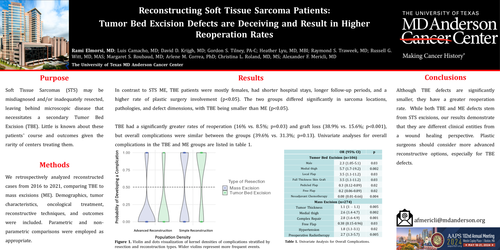
Purpose: Soft Tissue Sarcomas (STS) may be misdiagnosed and/or inadequately resected, leaving behind microscopic disease that necessitates a secondary Tumor Bed Excision (TBE). Little is known about these patients’ course and outcomes given the rarity of centres treating them.
Methods: We retrospectively analysed reconstructed cases from 2016 to 2021, comparing TBE to mass excisions (ME). Demographics, tumor characteristics, oncological treatment, reconstructive techniques, and outcomes were included. Parametric and non-parametric comparisons were employed as appropriate.
Results: In contrast to STS ME, TBE patients were mostly females, had shorter hospital stays, longer follow-up periods, and a higher rate of plastic surgery involvement (p<0.05). The two groups differed significantly in sarcoma locations, pathologies, and defect dimensions, with TBE being smaller than ME (p<0.05). TBE had a significantly greater rates of reoperation (16% vs. 8.5%; p=0.03) and graft loss (38.9% vs. 15.6%; p<0.001), but overall complications were similar between the groups (39.6% vs. 31.3%; p=0.13). Univariate analyses for overall complications in the TBE and ME groups are listed in table 1.
Conclusions: Although TBE defects are significantly smaller, they have a greater reoperation rate. While both TBE and ME defects stem from STS excisions, our results demonstrate that they are different clinical entities from a wound healing perspective. Plastic surgeons should consider more advanced reconstructive options, especially for TBE defects.
Table 1. Univariate Analysis for Overall Complications in Tumor Bed Excision (TBE) and Mass Excision (ME) STS Patients
|
OR (95% CI) |
p |
|
|
TBE (n=106) |
||
|
Male |
2.3 (1.05-5.1) |
0.03 |
|
Medial thigh |
5.7 (1.7-19.2) |
0.002 |
|
Local Flap |
3.5 (1.1-11.2) |
0.03 |
|
Full Thickness Skin Graft |
3.5 (1.1-11.2) |
0.03 |
|
Pedicled Flap |
0.3 (0.12-0.89) |
0.02 |
|
Free Flap |
0.2 (0.06-0.89) |
0.02 |
|
Neoadjuvant Chemotherapy |
0.08 (0.01-0.66) |
0.004 |
|
ME (n=274) |
||
|
Tumor Thickness |
1.1 (1 – 1.1) |
0.005 |
|
Medial thigh |
2.6 (1.4-4.7) |
0.002 |
|
Complex Repair |
2.8 (1.6-4.9) |
0.001 |
|
Free Flap |
0.38 (0.15-0.96) |
0.03 |
|
HTN |
1.8 (1.1-3.1) |
0.02 |
|
Preoperative Radiotherapy |
2.7 (1.3-5.7) |
0.005 |