203 posters, 14 topics, 5 sessions, 817 authors, 256 institutions
ePostersLive by SciGen Technologies S.A. All rights reserved.
The AAPS 102nd Annual Meeting
May 18-21, 2024 | The Westin Copley Place, Boston, MA

D71
Tracheal Reconstruction: Classification And Algorithm
Poster Presenter
Authors
Affiliations
Part of Topic
General Reconstruction
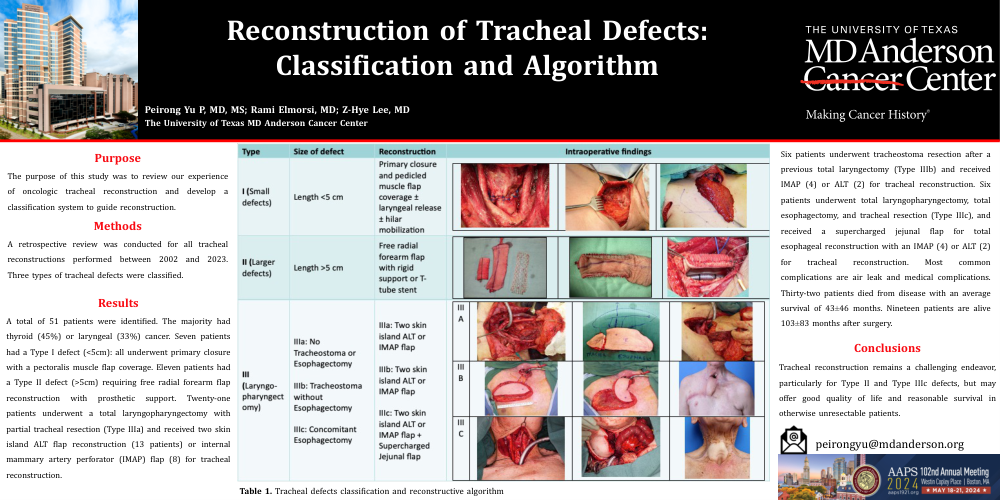
Reconstruction of Tracheal Defects: Classification and Algorithm
Purpose: The purpose of this study was to review our experience of oncologic tracheal reconstruction and develop a classification system to guide reconstruction. Methods: A retrospective review was conducted for all tracheal reconstructions performed between 2002 and 2023. Three types of tracheal defects were classified. Results: A total of 51 patients were identified. The majority had thyroid (45%) or laryngeal (33%) cancer. Seven patients had a Type I defect (<5cm): all underwent primary closure with a pectoralis muscle flap coverage. Eleven patients had a Type II defect (>5cm) requiring free radial forearm flap reconstruction with prosthetic support. Twenty-one patients underwent a total laryngopharyngectomy with partial tracheal resection (Type IIIa) and received two skin island ALT flap reconstruction (13 patients) or internal mammary artery perforator (IMAP) flap (8) for tracheal reconstruction. Six patients underwent tracheostoma resection after a previous total laryngectomy (Type IIIb) and received IMAP (4) or ALT (2) for tracheal reconstruction. Six patients underwent total laryngopharyngectomy, total esophagectomy, and tracheal resection (Type IIIc), and received a supercharged jejunal flap for total esophageal reconstruction with an IMAP (4) or ALT (2) for tracheal reconstruction. Most common complications are air leak and medical complications. Thirty-two patients died from disease with an average survival of 43±46 months. Nineteen patients are alive 103±83 months after surgery. Conclusions: Tracheal reconstruction remains a challenging endeavor, particularly for Type II and Type IIIc defects, but may offer good quality of life and reasonable survival in otherwise unresectable patients.