203 posters, 14 topics, 5 sessions, 817 authors, 256 institutions
ePostersLive by SciGen Technologies S.A. All rights reserved.
The AAPS 102nd Annual Meeting
May 18-21, 2024 | The Westin Copley Place, Boston, MA

D138
Does Frailty Predict Outcomes In Patients Undergoing Local, Regional Or Free Flap Procedures At The Time Of Craniotomy? An Analysis Of The ACS-NSQIP Database (2011-2021)
Poster Presenter
Part of Topic
General Reconstruction
Introduction
•Complications after craniotomy, one of the most common neurosurgical procedures, include surgical site infection, myocardial infarction, and sepsis.
•Patients at high-risk for complications may undergo concurrent plastic surgery procedures such as local, regional or free flaps.
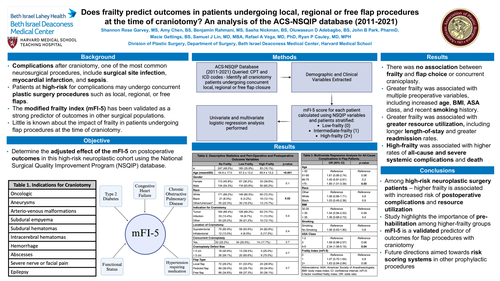
•The modified frailty index (mFI-5) has been validated as a strong predictor of outcome in other surgical populations.
•Little is known about the impact of frailty in patients undergoing flap procedures at the time of craniotomy.
Objective
•Determine the adjusted effect of the mFI-5 on postoperative outcomes in this high-risk neuroplastic cohort using the National Surgical Quality Improvement Program (NSQIP) database.
Results
•There was no association between frailty and flap choice or concurrent cranioplasty.
•Greater frailty was associated with multiple preoperative variables including increased age, BMI, ASA class, and recent smoking history.
•Greater frailty was associated with greater resource utilization including longer length-of-stay and greater readmission rates.
•High-frailty was associated with higher rates of all-cause and severe systemic complications and death
Conclusions
•Among high-risk neuroplastic surgery patients – higher frailty is associated with increased risk of postoperative complications and resource utilization
•Study highlights importance of pre-habilitation among higher-frailty groups
•mFI-5 is validated predictor of outcomes for flap procedures with craniotomy
•Future directions aimed towards risk scoring systems in other prophylactic procedures