203 posters, 14 topics, 5 sessions, 817 authors, 256 institutions
ePostersLive by SciGen Technologies S.A. All rights reserved.
The AAPS 102nd Annual Meeting
May 18-21, 2024 | The Westin Copley Place, Boston, MA

D145
Advances In Pre-treatments Of The Ex-vivo Vascularized Composite Allograft: A Systematic Review
Poster Presenter
Part of Topic
General Reconstruction
Advances in Pre-treatments of the Ex-vivo Vascularized Composite Allograft: A Systematic Review
Caroline E. Baker BSE1*, Thor S. Stead ScB1*, Alay R. Shah MD1, David L. Tran MD1, Sachin Chinta BS1, Hilliard T. Brydges BS1, Matteo Laspro BA1, Bruce E. Gelb MD2, Eduardo D. Rodriguez MD DDS1, Piul S. Rabbani PhD1
1Hansjörg Wyss Department of Plastic Surgery, NYU Langone Health, New York, NY, 2Department of Surgery, NYU Langone Health, New York, NY
* denotes authors with equivalent contributions
INTRODUCTION
Vascularized composite allografts (VCAs) are comprised of multiple tissue types each with a unique physiological profile. Management of tissue viability throughout the transplantation process is necessary for safe and successful patient outcomes. A key opportunity for intervention is graft pre-treatment (PT), in the window between harvest and transplant. The current gold standard PT is a graft flush followed by static cold storage with the University of Wisconsin solution (UW). Graft viability is limited to 4-6 hours.1 In this short time, donor-recipient matching, graft allocation, and tolerance induction are limited or impossible. This purpose of this systematic review of the literature is to present novel PT strategies and their results, along with practical considerations.
METHODS
Following PRISMA guidelines, a literature search was conducted with the following parameters
• Databases: PubMed, Cochrane and Embase • Key Terms: 33, related to VCA grafts and transplantation
• Exclusion Criteria: abstracts, commentaries, editorials, non-English articles, review papers, and PT interventions targeting immunogenicity rather than cell physiology
Based on the findings from data extraction, articles were organized into three categories: solution-based alterations to the gold standard, ex-vivo perfusion, or other novel techniques
RESULTS
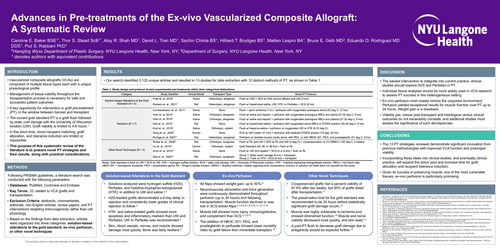
Our search identified 3,125 unique articles and resulted in 13 studies for data extraction with 12 distinct methods of PT, as shown in Table 1.
(Table 1)
Solution-based Alterations to the Gold Standard: Solutions analyzed were hydrogen sulfide (H2S), Perfadex, and histidine-tryptophan-ketoglutarate (HTK), in addition to UW and saline.2,3 H2S-treated grafts demonstrated a 6-day delay in rejection and consistently lower grades of clinical rejection to follow.2 HTK- and saline-treated grafts showed more apoptosis and inflammatory markers than UW and Perfadex. UW or Perfadex was recommended.3 Skin, blood vessels, nerves, and muscle showed damage most quickly. Bone was fairly resilient.3
Ex-vivo Perfusion: All flaps showed weight gain, up to 50%.8 Neuromuscular stimulation and force generation were continuously demonstrated throughout perfusion (up to 24 hours) and following transplantation. Muscle function declined or was lost in SCS-stored flaps.2,3,4,5,6,7,8,9,10,11,12,13,14 Muscle still showed more injury, immunoglobulins, and complement than SCS.4,7,9,10 The addition of HBOC-201, PEG, and prostaglandin to perfusate showed lower mortality rates by graft failure than immediate transplant.10
Other Novel Techniques: Cryopreserved grafts had a percent viability of 91.9% after two weeks, but 90% of grafts failed after transplantation.11 The preservation limit for the gold standard was recommended to be 24 hours before statistically significant graft damage occurs.12 Muscle was highly vulnerable to ischemia and showed diminished function.14 Muscle and nerve viability decreased most quickly, and skin least.12 A post-PT flush to decrease graft damage due to antigenicity should be explored further.13
DISCUSSION
The easiest intervention to integrate into current practice, clinical studies should explore H2S and Perfadex in PT. Individual tissue analyses should be more widely used in VCA research to assess PT success in this heterogeneous setting. Ex-vivo perfusion most closely mimics the corporeal environment. Perfusion yielded exceptional results for muscle function over PT up to 24 hours. Weight gain is a drawback. Viability pre- versus post-transplant and histological versus clinical outcomes do not necessarily correlate, and additional studies must assess the significance of such discrepancies.
CONCLUSIONS
The 13 PT strategies reviewed demonstrate significant innovation from previous methodologies with improved VCA function and prolonged viability. Incorporating these ideas into clinical studies, and eventually clinical practice, will expand the donor pool and increase time for graft allocation and recipient tolerance induction. Given its success in preserving muscle, one of the most vulnerable tissues, ex-vivo perfusion is particularly promising.
REFERENCES
-
MuramatsuI,TakahataN,UsuiM,IshiiS.Metabolicandhistologicchangesintheischemicmusclesofreplanteddoglegs.ClinOrthopRelatRes.1985;(196):292-299.
-
FriesCA,LawsonSD,WangLC,etal.CompositeGraftPretreatmentWithHydrogenSulfideDelaystheOnsetofAcuteRejection.AnnPlastSurg.2019;82(4):452-458.
doi:10.1097/SAP.0000000000001693
-
RostamiS,XuM,DattaS,HaykalS.EvaluationofEarlyMarkersofIschemia-reperfusionInjuryandPreservationSolutionsinaModifiedHindlimbModelofVascularized
Composite Allotransplantation. Transplant Direct. 2022;8(1):e1251. doi:10.1097/TXD.0000000000001251
-
ConstantinescuMA,KnallE,XuX,etal.Preservationofamputatedextremitiesbyextracorporealbloodperfusion;afeasibilitystudyinaporcinemodel.JSurgRes.
2011;171(1):291-299. doi:10.1016/j.jss.2010.01.040
-
OzerK,Rojas-PenaA,MendiasCL,BrynerB,ToomasianC,BartlettRH.ExSituLimbPerfusionSystemtoExtendVascularizedCompositeTissueAllograftSurvivalin
Swine. Transplantation. 2015;99(10):2095-2101. doi:10.1097/TP.0000000000000756
-
OzerK,Rojas-PenaA,MendiasCL,BrynerBS,ToomasianC,BartlettRH.TheEffectofExSituPerfusioninaSwineLimbVascularizedCompositeTissueAllografton
Survival up to 24 Hours. J Hand Surg Am. 2016;41(1):3-12. doi:10.1016/j.jhsa.2015.11.003
-
GokE,AlghanemF,MoonR,etal.DevelopmentofanEx-SituLimbPerfusionSystemforaRodentModel.ASAIOJ.2019;65(2):167-172.
doi:10.1097/MAT.0000000000000786
-
KruitAS,SmitsL,PouwelsA,SchreinemachersMCJM,HummelinkSLM,UlrichDJO.Ex-vivoperfusionasasuccessfulstrategyforreductionofischemia-reperfusion
injury in prolonged muscle flap preservation - A gene expression study. Gene. 2019;701:89-97. doi:10.1016/j.gene.2019.03.021
-
HaugV,KollarB,TasigiorgosS,etal.HypothermicExSituPerfusionofHumanLimbsWithAcellularSolutionfor24Hours.Transplantation.2020;104(9):e260-e270.
doi:10.1097/TP.0000000000003221
-
Burlage LC, Lellouch AG, Taveau CB, et al. Optimization of Ex Vivo Machine Perfusion and Transplantation of Vascularized Composite Allografts. J Surg Res.
2022;270:151-161. doi:10.1016/j.jss.2021.09.005
-
Rinker B, Cui XD, Cibull ML, Fink BF, Gao DY, Vasconez HC. Cryopreservation of composite tissue transplants. Hand (N Y). 2008;3(1):17-23. doi:10.1007/s11552-007-
9062-2
-
Liu Q, Li Q, Zheng S, Zheng D. Preservation of canine composite facial flaps using UW solution. Arch Facial Plast Surg. 2010;12(4):263-268.
doi:10.1001/archfacial.2010.47
-
Amin KR, Ball AL, Chhina C, et al. Ex-vivo flush of the limb allograft reduces inflammatory burden prior to transplantation. J Plast Reconstr Aesthet Surg. 2018;71(2):140-
146. doi:10.1016/j.bjps.2017.11.002
-
Gok E, Kubiak CA, Guy E, Kemp SWP, Ozer K. Effect of Static Cold Storage on Skeletal Muscle after Vascularized Composite Tissue Allotransplantation. J Reconstr