212 posters, 10 topics, 5 sessions, 754 authors, 237 institutions
ePostersLive by SciGen Technologies S.A. All rights reserved.
The AAPS 101st Annual Meeting
29 April – 2 May, 2023 | Chicago, IL

D32
Long-term Outcomes Comparing Between Single Versus Dual Innervated Free Functional Gracilis Muscle Transfer In Longstanding Facial Paralysis Patients
Poster Presenter
Authors
Roshni Thachil, Y. Edward Wen, Adolfo Zamora, Cristina V. Sanchez, Shai Rozen
Affiliations
Part of Topic
General Reconstruction
Long-term Outcomes Comparing Between Single Versus Dual Innervated Free Functional Gracilis Muscle Transfer In Longstanding Facial Paralysis Patients
Roshni Thachil, BS; Y. Edward Wen, BA; Adolfo Zamora, MD; Cristina V. Sanchez, BSA; Shai Rozen, MD*
Introduction:
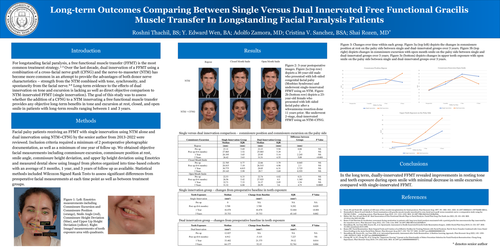
For longstanding facial paralysis, a free functional muscle transfer (FFMT) is the most common treatment strategy.1-3 Over the last decade, dual innervation of a FFMT using a combination of a cross-facial nerve graft (CFNG) and the nerve-to-masseter (NTM) has become more common in an attempt to provide the advantages of both donor nerve characteristics – strength from the NTM combined with tone, synchroneity, and spontaneity from the facial nerve.4-8 Long-term evidence to the effects of dual innervation on tone and excursion is lacking as well as direct objective comparison to NTM-innervated FFMT (single innervation). The goal of this study was to assess whether the addition of a CFNG to a NTM innervating a free functional muscle transfer provides any objective long-term benefits in tone and excursion at rest, closed, and open smile in patients with long-term results ranging between 1 and 3 years.
Methods:
Facial palsy patients receiving an FFMT with single innervation using NTM alone and dual innervation using NTM+CFNG by the senior author from 2013-2022 were reviewed. Inclusion criteria required a minimum of 2 postoperative photographic documentation, as well as a minimum of one year of follow up. We obtained objective facial measurements including commissure excursion, commissure position at rest, smile angle, commissure height deviation, and upper lip height deviation using Emotrics and measured dental show using ImageJ from photos organized into time-based cohorts with an average of 3 months, 1 year, and 3 years of follow up as available. Statistical methods included Wilcoxon Signed Rank Tests to assess significant differences from preoperative facial measurements at each time point as well as between treatment groups.
Conclusions:
In the long term, dually-innervated FFMT revealed improvements in resting tone and teeth exposure during open smile with minimal decrease in smile excursion compared with single-innervated FFMT.