212 posters, 10 topics, 5 sessions, 754 authors, 237 institutions
ePostersLive by SciGen Technologies S.A. All rights reserved.
The AAPS 101st Annual Meeting
29 April – 2 May, 2023 | Chicago, IL

D106
Outcomes Of Calvarial And Soft Tissue Reconstruction With Latissimus Dorsi Rib Osteomyocutaneous Free Flap
Poster Presenter
Authors
Abigail Meyers, Bahar Bassiri Gharb, Majid Rezaei, Brian Figueroa, Michael Annunziata, Sean Nagel, Mark Bain, Sudish Murthy, Francis Papay, Antonio Rampazzo
Affiliations
Cleveland Clinic Department of Plastic Surgery, Cleveland Clinic Department of Neurosurgery, Cleveland Clinic Department of Thoracic and Cardiovascular Surgery
Part of Topic
General Reconstruction
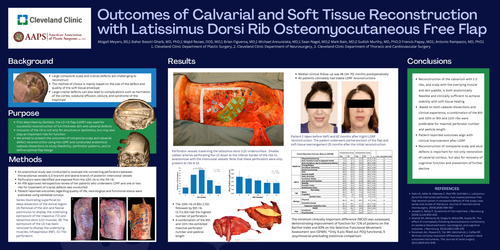
Outcomes of Calvarial and Soft Tissue Reconstruction
with Latissimus Dorsi Rib Osteomyocutaneous Free Flap
Abigail Meyers, BS;1 Bahar Bassiri Gharb, MD, PhD;1 Majid Rezaei, DDS, MD;1 Brian Figueroa, MD;1 Michael Annunziata, MD;1 Sean Nagel, MD;2 Mark Bain, MD;2 Sudish Murthy, MD, PhD;3 Francis Papay, MD1; Antonio Rampazzo, MD, PhD1
Large composite scalp and cranial defects are challenging to
reconstruct
The method of choice is mainly based on the size of the defect and
quality of the soft tissue envelope
Large cranial defects can also lead to complications such as herniation
of the cortex, subdural effusion, seizure, and syndrome of the
trephined
First described by Gottleib, the LD-rib flap (LDRF) was used for
successful reconstruction of full thickness skin and calvarial defects
Inclusion of the rib is not only for structure or aesthetics, but may also
play an important role for function
We aimed to present the outcomes of composite scalp and calvarial
defect reconstruction using the LDRF and conducted anatomical
cadaver dissections to study feasibility, perforator patterns, and to
define optimal flap design
An anatomical study was conducted to evaluate the connecting perforators between
thoracodorsal vessels (LD branch) and lateral branch of posterior intercostal vessels
Perforators were identified and exposed from the 12th rib to the 7th rib
An IRB-approved retrospective review of ten patients who underwent LDRF and one or two
ribs for treatment of cranial defects was conducted
Patient-reported outcomes regarding quality of life, neurological and functional status were
evaluated using validated surveys
Series illustrating superficial-todeep
dissection of the dorsal region.
(A) Removal of the skin and fascial
panniculus to display the underlying
epimysium of the trapezius (TZ) and
latissimus dorsi (LD) muscles. (B) The
epimysium of the LD has been
removed to display the underlying
muscles; infraspinatus (INF). (C) The
perforators.
The 10th rib (4.65± 2.01)
followed by 9th rib
(3.7±1.63) had the highest
number of perforators
A combination of the 9th
and 11th ribs exhibited
maximal perforator
number and pedicle
length
The minimum clinically important difference (MCID) was surpassed,
demonstrating improvement of function for 71% of patients on the
Barthel Index and 63% on the Selective Functional Movement
Assessment test (SFMA). *Only 6 pts filled out PDQ functional, 5
psychosocial precluding statistical comparison.
Median clinical follow-up was 48 [34-70] months postoperatively
All patients ultimately had stable LDRF reconstructions
Reconstruction of the calvarium with 1-2
ribs, and scalp with the overlying muscle
and skin paddle, is both anatomically
feasible and clinically sufficient to achieve
stability with soft tissue healing
Based on both cadaver dissections and
clinical experience, a combination of the 8th
and 10th or 9th and 11th ribs were
preferable for maximal perforator number
and pedicle length
Patient-reported outcomes align with
clinical improvement after LDRF
Reconstruction of composite scalp and skull
defects is important for not only restoration
of calvarial contour, but also for recovery of
cognitive function and prevention of further
decline