212 posters, 10 topics, 5 sessions, 754 authors, 237 institutions
ePostersLive by SciGen Technologies S.A. All rights reserved.
The AAPS 101st Annual Meeting
29 April – 2 May, 2023 | Chicago, IL

D130
Relative Outcomes Of Flap-Based Reconstruction And Incisional Negative-Pressure Wound Therapy For Groin Coverage In The Setting Of Vascular Intervention
Poster Presenter
Authors
Kaamya Varagur, Karim Saoud, Sai Pinni, Janessa Sullivan, Joani Christensen
Affiliations
Part of Topic
General Reconstruction
Relative Outcomes of Flap-Based Reconstruction and Incisional Negative-Pressure Wound Therapy for Groin Coverage in the Setting of Vascular Intervention
Kaamya Varagur, MPhil1; Karim Saoud, BS1; Janessa Sullivan, BA1; Sai L. Pinni, BS1; Gary B. Skolnick, MBA1; Justin M. Sacks, MD, MBA1; Amy F. Kells, MD, PhD1; Joani M. Christensen, MD1
1. Washington University in St. Louis Division of Plastic and Reconstructive Surgery, Department of Surgery, St. Louis, MO
• Vascular operations in the groin face high
rates of wound complications that
threaten both the underlying vascular
reconstruction and limb
• Pedicled rectus femoris or sartorius
muscle flaps and incisional negativepressure
wound therapy (iNPWT) can be
used for groin coverage either
prophylactically, or to manage
complications such as groin infection.
• Prior work has not studied the relative use
of these flaps in prophylactic contexts,
and has not examined the benefit of
iNPWT alone
Aims
• To compare outcomes of sartorius muscle flap, rectus femoris muscle flap, and
iNPWT alone for prophylactic groin coverage following vascular surgery
• To examine relative outcomes of rectus femoris versus sartorius muscle flap
when indicated for groin complications
Methods
Retrospective chart review of
demographics, comorbidities,
interventions, and complications
• Bivariate and multivariate Firth
logistic regressions
Results
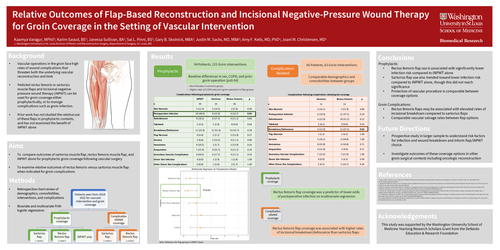
• Rectus femoris flap coverage was a predictor of lower odds
of postoperative infection on multivariate regression
• Rectus femoris flap coverage was associated with higher rates
of incisional breakdown/dehiscence than sartorius flaps
Conclusions
Prophylactic
• Rectus femoris flap use is associated with significantly lower
infection risk compared to iNPWT alone
• Sartorius flap use also trended toward lower infection risk
compared to iNPWT alone, though this did not reach
significance
• Protection of vascular procedure is comparable between
coverage options
Groin Complications:
• Rectus femoris flaps may be associated with elevated rates of
incisional breakdown compared to sartorius flaps
• Comparable vascular salvage rates between flap options