212 posters, 10 topics, 5 sessions, 754 authors, 237 institutions
ePostersLive by SciGen Technologies S.A. All rights reserved.
The AAPS 101st Annual Meeting
29 April – 2 May, 2023 | Chicago, IL

PC63
Gluteal Based V-Y Flaps Are Effective And Efficient For Vaginal Reconstruction Following Abdominal-perineal Resection With Partial Vaginectomy
Poster Presenter
Authors
Keith Sweitzer, Claudia Tawil, Aidan O'Shea, Joseph Escandon, Derek Bell
Affiliations
Part of Topic
General Reconstruction
Gluteal Based V-Y Flaps are Effective and Efficient for Vaginal Reconstruction Following Abdominal-Perineal Resection with Partial Vaginectomy
Keith Sweitzer, MD, Claudia Tawil, BS, Aidan O’Shea, BS, James Butterfield, MD, Joseph Escandon, MD Derek Bell, MD
Division of Plastic Surgery, University of Rochester Medical Center
Background:
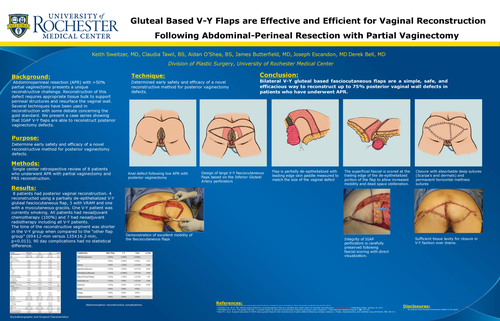
Abdominoperineal resection (APR) with >50% partial vaginectomy presents a unique reconstructive challenge. Reconstruction of this defect requires appropriate tissue bulk to support perineal structures and resurface the vaginal wall. Several techniques have been used in reconstruction with some debate concerning the gold standard. We present a case series showing that IGAP V-Y flaps are able to reconstruct posterior vaginectomy defects.
Purpose:
Determine early safety and efficacy of a novel reconstructive method for posterior vaginectomy defects.
Methods:
Single center retrospective review of 8 patients who underwent APR with partial vaginectomy and PRS reconstruction.
Results:
8 patients had posterior vaginal reconstruction. 4 reconstructed using a partially de-epithelialized V-Y gluteal fasciocutaneous flap, 3 with VRAM and one with a myocutaneous gracilis. One V-Y patient was currently smoking. All patients had neoadjuvant chemotherapy (100%) and 7 had neoadjuvant radiotherapy including all V-Y patients.
The time of the reconstructive segment was shorter in the V-Y group when compared to the “other flap group” (69±12-min versus 135±16.2-min, p=0.013). 90 day complications had no statistical difference.
Technique:
Determined early safety and efficacy of a novel reconstructive method for posterior vaginectomy defects.
Conclusion:
Bilateral V-Y gluteal based fasciocutaneous flaps are a simple, safe, and efficacious way to reconstruct up to 75% posterior vaginal wall defects in patients who have underwent APR.