212 posters, 10 topics, 5 sessions, 754 authors, 237 institutions
ePostersLive by SciGen Technologies S.A. All rights reserved.
The AAPS 101st Annual Meeting
29 April – 2 May, 2023 | Chicago, IL

PC61
Comparative Postoperative Complications Of Acellular Dermal Matrix And Mesh In Prepectoral And Subpectoral One Stage Direct To Implant Reconstruction: A Retrospective Cohort Study
Poster Presenter
Authors
Michael Diffley, Jamie Hall, Yitzchok Greenberg, Abigail Teitelbaum, Amy Tang, Donna Tepper, Vigen Darian, Maristella Evangelista, Dunya Atisha
Affiliations
Henry Ford Hospital, Henry Ford Hospital Department of General Surgery, Henry Ford Hospital Department of Plastic Surgery, Wayne State University School of Medicine, Henry Ford Hospital Department of Public Sciences
Part of Topic
Breast Reconstruction
Comparative Postoperative Complications of Acellular Dermal Matrix and Mesh Use in Prepectoral and Subpectoral One-Stage Direct to Implant Reconstruction: A Retrospective Cohort Study
Michael Diffley, MD; Jamie Hall MD; Yitzchok Greenberg, MD; Amy Tang PhD; Donna Tepper MD; Vigen Darian MD; Maristella Evangelista MD; Dunya Atisha MD
Henry Ford Hospital, Detroit, Michigan
Immediate direct to implant (DTI) prepectoral reconstruction has increasingly popular due to1,2:
Improved aesthetic outcomes
Improved psychological well-being
Decreased animation deformity
Improved physical functioning
Decreased recovery time
Historically immediate DTI has been associated with higher rates of:
Seroma, infection, contracture, and explantation1,2
Immediate DTI, specifically prepectoral, requires use of acellular dermal matrix (ADM)
To provide a safer approach to DTI, we evaluated the complication profile associated with the different types of dermal matrices and surgical meshes available for use in immediate DTI reconstruction.
A retrospective cohort study of patients undergoing immediate DTI reconstruction in either the prepectoral or subpectoral plane from 2019-2022 at a large metropolitan healthcare system was performed
Data extracted included:
Demographics, comorbidities, procedural details, cancer treatments received, and major and minor complications
Univariate and multivariate analyses
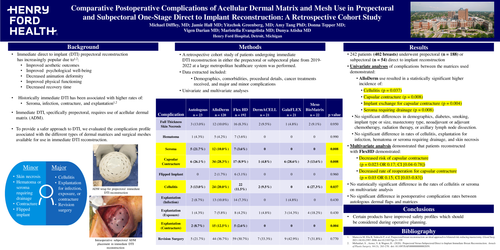
2 patients (402 breasts) underwent prepectoral (n = 188) or subpectoral (n = 54) direct to implant reconstruction
Univariate analyses of complications between the matrices used demonstrated:
AlloDerm use resulted in a statistically significant higher incidence of:
Cellulitis (p = 0.037)
Capsular contracture (p = 0.008)
Implant exchange for capsular contracture (p = 0.004)
Seroma requiring drainage (p = 0.008)
No significant differences in demographics, diabetes, smoking, implant type or size, mastectomy type, neoadjuvant or adjuvant chemotherapy, radiation therapy, or axillary lymph node dissection.
No significant difference in rates of cellulitis, explantation for infection, hematoma or seroma requiring drainage, and skin necrosis
Multivariate analysis demonstrated that patients reconstructed with FlexHD demonstrated:
Decreased risk of capsular contracture
Decreased rate of reoperation for capsular contracture
No statistically significant difference in the rates of cellulitis or seroma on multivariate analysis
No significant difference in postoperative complication rates between autologous dermal flaps and matrices
Certain products have improved safety profiles which should be considered during operative planning