212 posters, 10 topics, 5 sessions, 754 authors, 237 institutions
ePostersLive by SciGen Technologies S.A. All rights reserved.
The AAPS 101st Annual Meeting
29 April – 2 May, 2023 | Chicago, IL

D105
Latissimus Dorsi Flap With Immediate Fat Grafting (lift) For Autologous Breast Reconstruction: A Comparative Study
Poster Presenter
Authors
Affiliations
Part of Topic
Breast Reconstruction
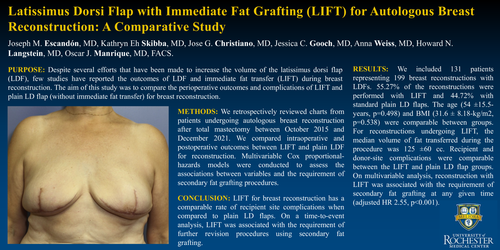
PURPOSE: Despite several efforts that have been made to increase the volume of the latissimus dorsi flap (LDF), few studies have reported the outcomes of LDF and immediate fat transfer (LIFT) during breast reconstruction. The aim of this study was to compare the perioperative outcomes and complications of LIFT and plain LD flap (without immediate fat transfer) for breast reconstruction.
METHODS: We retrospectively reviewed charts from patients undergoing autologous breast reconstruction after total mastectomy between October 2015 and December 2021. We compared intraoperative and postoperative outcomes between LIFT and plain LDF for reconstruction. Multivariable Cox proportional-hazards models were conducted to assess the associations between variables and the requirement of secondary fat grafting procedures.
RESULTS: We included 131 patients representing 199 breast reconstructions with LDFs. 55.27% of the reconstructions were performed with LIFT and 44.72% with standard plain LD flaps. The age (54 ±15.5-years, p=0.498) and BMI (31.6 ±8.18-kg/m2, p=0.538) were comparable between groups. For reconstructions undergoing LIFT, the median volume of fat transferred during the procedure was 125 ±60 cc. Recipient and donor-site complications were comparable between the LIFT and plain LD flap groups. On multivariable analysis, reconstruction with LIFT was associated with the requirement of secondary fat grafting at any given time (adjusted HR 2.55, p<0.001).
CONCLUSION: LIFT for breast reconstruction has a comparable rate of recipient site complications when compared to plain LD flaps. On a time-to-event analysis, LIFT was associated with the requirement of further revision procedures using secondary fat grafting.