212 posters, 10 topics, 5 sessions, 754 authors, 237 institutions
ePostersLive by SciGen Technologies S.A. All rights reserved.
The AAPS 101st Annual Meeting
29 April – 2 May, 2023 | Chicago, IL

D102
A Systematic Review Comparing Biologic Vs Synthetic Meshes In Implant-based Breast Reconstruction
Poster Presenter
Part of Topic
Breast Reconstruction
Introduction:
Breast cancer is the most common malignancy in women globally.1 Implant-based breast reconstruction (IBBR) is currently the most popular type of postmastectomy breast reconstruction,2 and recently the use of surgical mesh in IBBR has become commonplace.3
Surgical meshes are divided into two broad categories: biologics and synthetics. Biologic meshes are made of human or animal tissues that have been stripped of their antigenic properties and processed into matrices of collagen and elastin.4 Synthetic meshes are made of manufactured polymers that can be knitted or woven, absorbable or non-absorbable, and are generally available at a much lower cost than biologic matrices.5 Within each mesh category there are many products currently on the market, each with their own reported advantages and disadvantages.
Though there is a long-standing belief that biologic mesh is superior to synthetic mesh in terms of surgical complications and patient outcomes, few studies exist to support this claim. This systematic review evaluates all published studies comparing biologic and synthetic meshes in IBBR, to determine which category of mesh produces the most favorable outcomes.
Methods:
Search Strategy and Study Inclusion Criteria:
A systematic search of the Embase, PubMed, and Cochrane databases was performed in January 2022 according to PRISMA guidelines. Primary literature studies investigating clinical outcomes of IBBR performed with synthetic and biologic surgical mesh after oncologic or prophylactic mastectomy were considered. Only studies comparing biologic and synthetic meshes within the same experimental framework were included. Papers were excluded if they were based on case studies, animal models, or in vitro experimentation. Two independent reviewers repeated the screening process.
Study Assessment and Data Extraction:
Outcomes of interest covered a range of surgical complications typically associated with breast reconstruction. In several papers, longitudinal and subjective outcomes were also collected. For each included article, information regarding the study design, types of mesh used, patient metrics, and outcomes or complication rates was extracted. In all cases, a P value of < 0.05 was considered statistically significant. Study quality and bias was assessed using the validated Methodological Index for Non-Randomized Studies (MINORS) criteria.6 MINORS scores were determined separately by 2 independent reviewers, and the average score was reported.
Results (summarized):
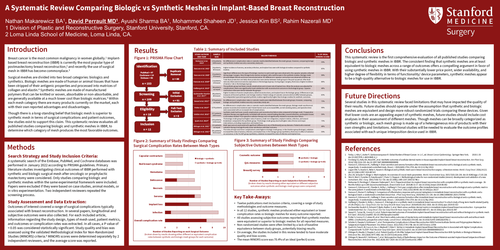
This systematic review is the first comprehensive evaluation of all published studies comparing biologic and synthetic meshes in IBBR. The consistent finding that synthetic meshes are at least equivalent to biologic meshes across a range of outcomes offers a compelling argument in favor of using synthetic meshes in IBBR. With their substantially lower price point, wider availability, and higher degree of flexibility in terms of functionality/ device parameters, synthetic meshes appear to be a high-quality alternative to biologic meshes for use in IBBR.
Future Directions:
Several studies in this systematic review faced limitations that may have impacted the quality of their results. Future studies should operate under the assumption that synthetic and biologic meshes are equivalent and design more robust randomized trials comparing these devices. Given that lower costs are an appealing aspect of synthetic meshes, future studies should include cost analyses in their assessment of different meshes. Though meshes can be broadly categorized as synthetic or biologic, each mesh group is made up of a heterogeneous mix of products with their own strengths and limitations. Additional studies will be needed to evaluate the outcome profiles associated with each unique interposition device used in IBBR.