212 posters, 10 topics, 5 sessions, 754 authors, 237 institutions
ePostersLive by SciGen Technologies S.A. All rights reserved.
The AAPS 101st Annual Meeting
29 April – 2 May, 2023 | Chicago, IL

D152
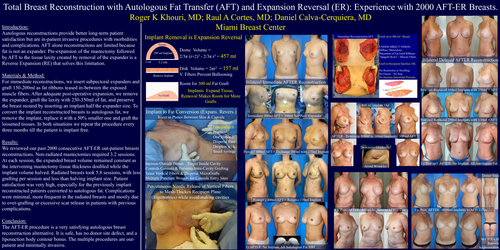
Total Breast Reconstruction With Autologous Fat Transfer (aft) And Reverse Expansion (er): Experience With 2000 Aft-er Breasts
Poster Presenter
Authors
Affiliations
Part of Topic
Breast Reconstruction
Total Breast Reconstruction with Autologous Fat Transfer (AFT) and Expansion Reversal (ER): Experience with 2000 AFT-ER Breasts.
Roger K Khouri, MD; Raul A Cortes, MD; Daniel Calva-Cerquiera, MD
Introduction: Miami Breast Center
Autologous reconstructions provide better long-term patient
satisfaction but are in-patient invasive procedures with morbidities
and complications. AFT alone reconstructions are limited because
fat is not an expander. Pre-expansion of the mastectomy followed
by AFT to the tissue laxity created by removal of the expander is a
Reverse Expansion (RE) that solves this limitation.
Materials & Method:
For immediate reconstructions, we insert subpectoral expanders and
graft 150-200ml as fat ribbons teased in-between the exposed
muscle fibers. After adequate post-operative expansion, we remove
the expander, graft the laxity with 250-350ml of fat, and preserve
the breast mound by inserting an implant half the expander size. To
convert the implant reconstructed breasts to autologous fat, we
remove the implant, replace it with a 50% smaller one and graft the
loosened tissues. In both situations we repeat the procedure every
three months till the patient is implant free.
Results:
We reviewed our past 2000 consecutive AFT-ER out-patient breasts
reconstructions. Non-radiated mastectomies required 3.2 sessions.
At each session, the expanded breast volume remained constant as
the intervening mastectomy tissue thickness doubled while the
implant volume halved. Radiated breasts took 5.8 sessions, with less
grafting per session and less than halving implant size. Patient
satisfaction was very high, especially for the previously implant
reconstructed patients converted to autologous fat. Complications
were minimal, more frequent in the radiated breasts and mostly due
to over-grafting or excessive scar release in patients with previous
complications.
Conclusion:
The AFT-ER procedure is a very satisfying autologous breast
reconstruction alternative. It is safe, has no donor site defect, and a
liposuction body contour bonus. The multiple procedures are outpatient
and minimally invasive.
2 cm 5.2 cm
Dome Volume =
2/3π (r+2)3 - 2/3π r3 = 457 ml
Disk Volume = 2πr2 = 157 ml
Remove Implant V. Fibers Prevent Ballooning
290 ml Implant
Tissue
Fat Graft
Implants Expand Tissue,
Removal Makes Room for More
Grafts
Room for 300 ml Fat Graft
Implant Removal is Expansion Reversal
Incision Outside Breast Finger Inside Cavity
Controls Cannula & Prevents Intra-Cavity Grafting
Tease Vertical Fibers & Disperse MicroGrafts
Multiple Puncture Wounds for Cannula Entry Sites
Implant to Fat Conversion (Expans. Revers.)
Inject in Planes Between Skin & Capsule
Lipografter®
Practical,
One Handed,
Disperse Fine
Droplets with
Small Syringe.
Percutaneous Needle Release of Vertical Fibers
to Mesh-Thicken Recipient Plane
(Rigottomies) while avoid making cavities
Bilateral Immediate AFTER Reconstruction
Immediate 400ml AFT + 300ml Sub Pect. Expander
Postop1 400ml AFT + Exchange 300ml with 170ml Implant
Postop#2 400ml AFT + Remove 170ml Implant
1y AFTER No Implant, All Autologous Fat MRI
Downsize Gradually!
Avoid Wrinkles
AFTER - Downsize 800ml to 360ml Implant + 300 ml AFT
800 ml Implant Out
1 y. Post AFTER 650ml Implants to AFT/ 3 Ops 1 y. Post AFTER 4800ml Implants to AFT/ 3 Ops
NO TOUCH
Buttock
Augmentation
Bilateral Delayed AFTER Reconstruction
Post op1 Replaced 550ml Implants with 250ml + AFT
Post op2 Replaced 250ml Implants with 130ml + AFT
1 y Post op3 AFTER: No Implant, All Autologous Fat
Donor Sites