212 posters, 10 topics, 5 sessions, 754 authors, 237 institutions
ePostersLive by SciGen Technologies S.A. All rights reserved.
The AAPS 101st Annual Meeting
29 April – 2 May, 2023 | Chicago, IL

D142
Concurrent Co-surgeon DIEP Flap Breast Reconstructions: Feasibility And Clinical Outcomes
Poster Presenter
Authors
Affiliations
Part of Topic
Breast Reconstruction
Concurrent Co-surgeon DIEP Flap Breast Reconstructions:
Feasibility and Clinical Outcomes
Christine S. Wang, MD; Abdl-Rawf Al-Nowaylati, MD; Niki Matusko, MS; Adeyiza O. Momoh, MD; Theodore A. Kung, MD
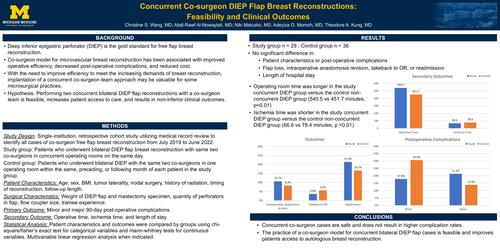
•Deep inferior epigastric perforator (DIEP) is the gold standard for free flap breast reconstruction.Study Design: Single-institution, retrospective cohort study utilizing medical record review to identify all cases of co-surgeon free flap breast reconstruction from July 2019 to June 2022.
Study group: Patients who underwent bilateral DIEP flap breast reconstruction with same two co-surgeons in concurrent operating rooms on the same day.
Control group: Patients who underwent bilateral DIEP with the same two co-surgeons in one operating room within the same, preceding, or following month of each patient in the study group.
Patient Characteristics: Age, sex, BMI, tumor laterality, nodal surgery, history of radiation, timing of reconstruction, follow-up length.
Surgical Characteristics: Weight of DIEP flap and mastectomy specimen, quantity of perforators in flap, flow coupler size, trainee experience.
Primary Outcome: Minor and major 90-day post-operative complications.
Secondary Outcome: Operative time, ischemia time, and length of stay.
Statistical Analysis: Patient characteristics and outcomes were compared by groups using chi-square/fisher’s exact test for categorical variables and mann-whitney tests for continuous variables. Multivariable linear regression analysis when indicated.