212 posters, 10 topics, 5 sessions, 754 authors, 237 institutions
ePostersLive by SciGen Technologies S.A. All rights reserved.
The AAPS 101st Annual Meeting
29 April – 2 May, 2023 | Chicago, IL

PC8
Prophylactic Axillary Lymphovenous Bypass Using The Branched Vein Graft Technique
Poster Presenter
Authors
Affiliations
Part of Topic
General Reconstruction
Prophylactic Axillary Lymphovenous Bypass Using The Branched Vein Graft Technique
Shelby Chun Fat, MD, MS, Brianne Mitchell, MD, Philip Brazio, MD
Cedars-Sinai Medical Center, Los Angeles, CA
Introduction
•Immediate lymphatic reconstruction (ILR) with lymphovenous bypass (LVB) prevents lymphedema1,2 after axillary lymph node dissection (ALND)
•Axillary LVB presents challenges including:
oSize mismatch between vein and lymphatic vessels
oNumber mismatch between vein and lymphatic vessels
oWidespread location of lymphatics
oAnastomotic reflux from high pressure veins
•Vein grafts have been used to address inadequate length3
•A branched vein graft (BVG) may offer further solutions
•Objective: To describe the technical details and preliminary outcomes of patients who underwent prophylactic LVB using a superficial circumflex iliac vein (SCIV) BVG
Methods
•Retrospective review
•Immediate lymphatic reconstruction using BVG by a single surgeon between September 2020 and November 2022
•Information collected:
oPatient demographics
oOperative details
oClinical outcomes
•Follow up measures included:
oBioimpedance analysis (BIA): 1mHz and 5mHz
oExcess volume
oPatient Reported Outcomes using LYMPH-Q: Symptoms, appearance, function, appearance, psychosocial subscales
Technique
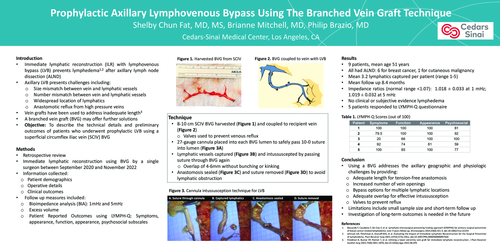
•8-10 cm SCIV BVG harvested (Figure 1) and coupled to recipient vein (Figure 2)
oValves used to prevent venous reflux
•27-gauge cannula placed into each BVG lumen to safely pass 10-0 suture into lumen (Figure 3A)
•Lymphatic vessels captured (Figure 3B) and intussuscepted by passing suture through BVG again
oOverlap of 4-6mm without bunching or kinking
•Anastomosis sealed (Figure 3C) and suture removed (Figure 3D) to avoid lymphatic obstruction
Results
•9 patients, mean age 51 years
•All had ALND: 6 for breast cancer, 1 for cutaneous malignancy
•Mean 3.2 lymphatics captured per patient (range 1-5)
•Mean follow up 8.4 months
•Impedance ratios (normal range <1.07): 1.018 ± 0.033 at 1 mHz; 1.019 ± 0.032 at 5 mHz
•No clinical or subjective evidence lymphedema
•5 patients responded to LYMPH-Q questionnaire
Conclusion
•Using a BVG addresses the axillary geographic and physiologic challenges by providing:
oAdequate length for tension-free anastomosis
oIncreased number of vein openings
oBypass options for multiple lymphatic locations
oAdequate overlap for effective intussusception
oValves to prevent reflux
•Limitations include small sample size and short-term follow up
•Investigation of long-term outcomes is needed in the future