212 posters, 10 topics, 5 sessions, 754 authors, 237 institutions
ePostersLive by SciGen Technologies S.A. All rights reserved.
The AAPS 101st Annual Meeting
29 April – 2 May, 2023 | Chicago, IL

D134
Comparison Of Nipple-Sparing Mastectomy Versus Skin-Sparing Mastectomy In Bilateral Implant-Based Breast Reconstruction With Unilateral Radiotherapy: A Matched Cohort Study
Poster Presenter
Part of Topic
Breast Reconstruction
Comparison Of Nipple-Sparing Mastectomy Versus Skin-Sparing Mastectomy In Bilateral Implant-Based Breast Reconstruction With Unilateral Radiotherapy: A Matched Cohort Study
PURPOSE:
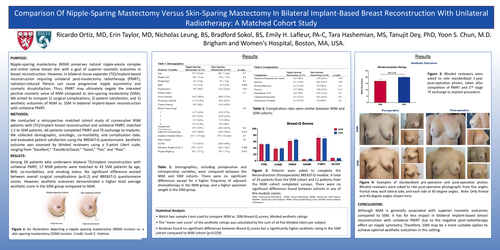
Nipple-sparing mastectomy (NSM) preserves natural nipple-areola complex and entire native breast skin with a goal of superior cosmetic outcomes in breast reconstruction. However, in bilateral tissue expander (TE)/implant-based reconstruction requiring unilateral post-mastectomy radiotherapy (PMRT), radiation-induced fibrosis can cause progressive nipple asymmetry and cosmetic dissatisfaction. Thus, PMRT may ultimately negate the intended positive cosmetic value of NSM compared to skin-sparing mastectomy (SSM). We aimed to compare 1) surgical complications, 2) patient satisfaction, and 3) aesthetic outcomes of NSM vs. SSM in bilateral implant-based reconstruction with unilateral PMRT.
METHODS:
We conducted a retrospective matched cohort study of consecutive NSM patients with (TE)/implant breast reconstruction and unilateral PMRT, matched 1:2 to SSM patients. All patients completed PMRT and TE exchange to implants. We collected demographic, oncologic, co-morbidity, and complication data, and evaluated patient satisfaction using the BREAST-Q questionnaire. Aesthetic outcome was assessed by blinded reviewers using a 5-point Likert scale, ranging from “Excellent,” “Excellent/Good,” “Good,” “Fair,” and “Poor.”
RESULTS:
Among 58 patients who underwent bilateral TE/implant reconstruction with unilateral PMRT, 17 NSM patients were matched to 41 SSM patients by age, BMI, co-morbidities, and smoking status. No significant difference existed between overall surgical complications (p=0.2) and BREAST-Q questionnaire scores. However, aesthetic outcomes demonstrated a higher total average aesthetic score in the SSM group compared to NSM.
CONCLUSIONS:
Although NSM is generally associated with superior cosmetic outcomes compared to SSM, it has far less impact in bilateral implant-based breast reconstruction with unilateral PMRT due to the negative post-radiotherapy effect on nipple symmetry. Therefore, SSM may be a more suitable option to achieve optimal aesthetic outcomes in this setting.