212 posters, 10 topics, 5 sessions, 754 authors, 237 institutions
ePostersLive by SciGen Technologies S.A. All rights reserved.
The AAPS 101st Annual Meeting
29 April – 2 May, 2023 | Chicago, IL

D117
Optimal Timing To Minimize Complications Of Alveolar Bone Grafting In Cleft Care
Poster Presenter
Authors
Sarah Alfeerawi, Idean Roohani, Pasha Shakoori, Collean Trotter, Dylan Choi, Artur Fahradyan, Jessica A. Lee, William P. Magee, Mark M. Urata, Jeffrey A. Hammoudeh
Affiliations
Division of Plastic and Maxillofacial Surgery, Children’s Hospital Los Angeles, Keck School of Medicine, University of Southern California, Division of Plastic and Reconstructive Surgery, Keck School of Medicine of USC
Part of Topic
Craniofacial/Peds
Optimal Timing to Minimize Complications of Alveolar Bone Grafting in Cleft Care
Primary goals of alveolar bone grafting (ABG) are to
promote maxillary arch stabilization, oronasal
fistulae closure, and nasal alar bases correction
• Traditionally, ABG classified according to
chronological age
o Primary ABG (2-5 years)
o Early secondary ABG (4-7 years)
o Late secondary ABG (8-12 years)
o Tertiary/delayed ABG (12+ years)
• Ideal timing of secondary ABG has yet to
standardized for patients with cleft lip and palate
• Retrospective review of the NSQIP database of
patients undergoing elective secondary ABG
from 2012-2021
• Patient demographics, postoperative outcomes,
and reoperation rates were collected
• Patients with an age of repair of less than 4 or
greater than 12 years, concurrent procedures,
and current or history of cancer were excluded
• Receiver-Operating Characteristics (ROC) curve
analysis ➝ determine the appropriate age
cutoff values
• Area Under the Curve (AUC)>0.700 was the
marker of adequate sensitivity and specificity
Results
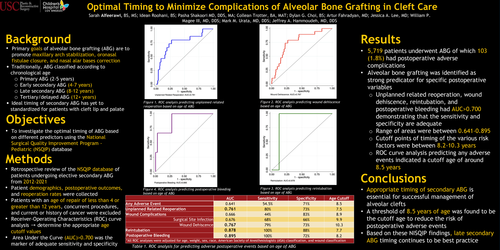
5,719 patients underwent ABG of which 103
(1.8%) had postoperative adverse
complications
• Alveolar bone grafting was identified as
strong predicator for specific postoperative
variables
o Unplanned related reoperation, wound
dehiscence, reintubation, and
postoperative bleeding had AUC>0.700
demonstrating that the sensitivity and
specificity are adequate
o Range of areas were between 0.641-0.895
o Cutoff points of timing of the various risk
factors were between 8.2-10.3 years
o ROC curve analysis predicting any adverse
events indicated a cutoff age of around
8.5 years
Conclusions
Appropriate timing of secondary ABG is
essential for successful management of
alveolar clefts
• A threshold of 8.5 years of age was found to be
the cutoff age to reduce the risk of
postoperative adverse events
• Based on these NISQIP findings, late secondary
ABG timing continues to be best practice