212 posters, 10 topics, 5 sessions, 754 authors, 237 institutions
ePostersLive by SciGen Technologies S.A. All rights reserved.
The AAPS 101st Annual Meeting
29 April – 2 May, 2023 | Chicago, IL

D111
Burden Of Care Of Delayed Extubation Following Mandibular Distraction Osteogenesis
Poster Presenter
Authors
Collean Trotter, BA, MAT, Naikhoba C.O. Munabi, MD, MPH, Dylan G. Choi, BS, Idean Roohani, BS, Sarah Alfeerawi, BS, MS, Artur Fahradyan, MD, Mark M. Urata, MD, DDS, Jeffrey A. Hammoudeh, MD, DDS
Affiliations
Division of Plastic and Maxillofacial Surgery, Children’s Hospital Los Angeles, Division of Plastic and Reconstructive Surgery, Keck School of Medicine, Keck School of Medicine of the University of Southern California
Part of Topic
Craniofacial/Peds
Burden of Care of Delayed Extubation Following Mandibular Distraction Osteogenesis
Collean Trotter, BA, MAT; Naikhoba C.O. Munabi, MD, MPH; Dylan G. Choi, BS; Idean Roohani, BS; Sarah Alfeerawi, BS; Artur Fahradyan, MD; Mark M. Urata, MD, DDS; Jeffrey A. Hammoudeh, MD, DDS
Background
-
Isolated congenital micrognathia affects 1 in 1,500 live births.
-
Mandibular distraction osteogenesis (MDO) offers an alternative to tracheostomy to treat severe obstructive sleep apnea secondary to micrognathia.
-
Despite increasing utilization of MDO, post-operative extubation failure rates range from 16-22%.
-
Polysomnography (PSG) metrics aid tracheostomy decannulation planning but are less commonly considered in extubation planning
-
Extubation timing also remains heavily institution and clinician dependent, recent studies demonstrate safety of immediate extubation
Objective
-
To identify the utility of preoperative PSG and extubation timing as predictors of extubation failure following mandibular distractor placement
-
IRB-approved retrospective review of pediatric patients undergoing MDO from 2006-2022.
-
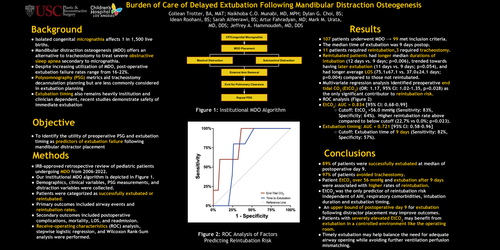
Our institutional MDO algorithm is depicted in Figure 1.
-
Demographics, clinical variables, PSG measurements, and distraction variables were collected.
-
Patients were categorized as successfully extubated or reintubated.
-
Primary outcomes included airway events and reintubation rates.
-
Secondary outcomes included postoperative complications, mortality, LOS, and readmission.
-
Receive-operating characteristics (ROC) analysis, stepwise logistic regression, and Wilcoxon Rank-Sum analysis were performed.
-
107 patients underwent MDO →99 met inclusion criteria.
-
The median time of extubation was 9 days postop.
-
11 patients required reintubation,3 required tracheostomy.
-
Reintubated patients had longer median durations of intubation (12 days vs. 9 days; p=0.006), trended towards having later extubation (11 days vs. 9 days; p=0.054), and had longer average LOS (75.1±67.1 vs. 37.0±24.1 days; p=0.004) compared to those not reintubated.
-
Multivariate regression analysis identified preoperative end tidal CO2 (EtCO2) (OR: 1.17, 95% CI: 1.02-1.35, p=0.028) as the only significant contributor to reintubation risk.
-
ROC analysis (Figure 2)
-
EtCO2: AUC = 0.834 [95% CI: 0.68–0.99]
-
Cutoff: EtCO2 >56.0 mmHg (Sensitivity: 83%, Specificity: 64%). Higher reintubation rate above compared to below cutoff (22.7% vs 0.0%; p=0.023).
-
Extubation timing: AUC = 0.721 [95% CI: 0.58–0.96]
-
Cutoff: Extubation time of 9 days (Sensitivity: 82%, Specificity: 57%).
Conclusions
-
89% of patients were successfully extubated at median of postoperative day 9.
-
97% of patients avoided tracheostomy.
-
Patient EtCO2 over 56 mmHg and extubation after 9 days were associated with higher rates of reintubation.
-
EtCO2 was the only predictor of reintubation risk independent of AHI, respiratory comorbidities, intubation duration and extubation timing.
-
An upper bound of postoperative day 9 for extubation following distractor placement may improve outcomes.
-
Patients with severely elevated EtCO2may benefit from extubation in a controlled environment like the operating room.
-
Timely extubation may help balance the need for adequate airway opening while avoiding further ventilation perfusion mismatching.