212 posters, 10 topics, 5 sessions, 754 authors, 237 institutions
ePostersLive by SciGen Technologies S.A. All rights reserved.
The AAPS 101st Annual Meeting
29 April – 2 May, 2023 | Chicago, IL

D112
Digital Simulation For Cleft Surgery Education: A 10-year Assessment Of Global Impact
Poster Presenter
Authors
Affiliations
Part of Topic
Craniofacial/Peds
Digital Simulation for Cleft Surgery Education: A 10-Year Assessment of Global Impact
Background
•Open-access, multi-media digital surgical simulators may provide an effective means to learn technically complex procedures in cleft and craniofacial surgery.
•These resources can provide an easily accessible surgical atlas for trainees nationally while addressing global disparities in surgery education
Objective
The objective of this article is to assess the demographics, usage, and global impact of an open access multimedia cleft and craniofacial simulator, in its 10th year since inception
Methods
•Usage data of the simulator over 10 years were retrospectively collected and analyzed.
• Data parameters included the number of users, sessions, countries reached, and content access.
Results
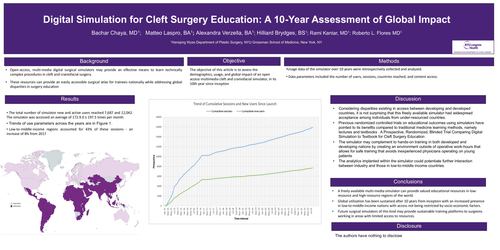
• The total number of simulator new and active users reached 7,687 and 12,042. The simulator was accessed an average of 172.9.0 ± 197.5 times per month.
• Trends of use parameters across the years are in Figure 1.
• Low-to-middle-income regions accounted for 43% of these sessions - an increase of 8% from 2017
Discussion
•Considering disparities existing in access between developing and developed countries, it is not surprising that this freely available simulator had widespread acceptance among individuals from under-resourced countries.
•Previous randomized controlled trials on educational outcomes using simulators have pointed to its benefits compared to traditional medicine learning methods, namely lectures and textbooks . A Prospective, Randomized, Blinded Trial Comparing Digital Simulation to Textbook for Cleft Surgery Education
•The simulator may complement to hands-on training in both developed and developing nations by creating an environment outside of operative work-hours that allows for safe training that avoids inexperienced physicians operating on young patients
•The analytics implanted within the simulator could potentiate further interaction between industry and those in low-to-middle income countries.
Conclusions
•A freely available multi-media simulator can provide valued educational resources in low-resource and high-resource regions of the world.
•Global utilization has been sustained after 10 years from inception with an increased presence in low-to-middle-income nations with access not being restricted by socio-economic factors.
•Future surgical simulators of this kind may provide sustainable training platforms to surgeons working in areas with limited access to resources.