212 posters, 10 topics, 5 sessions, 754 authors, 237 institutions
ePostersLive by SciGen Technologies S.A. All rights reserved.
The AAPS 101st Annual Meeting
29 April – 2 May, 2023 | Chicago, IL

D109
Determining The Effect Of Submuscular Versus Prepectoral Implant Position On Shoulder Girdle Dynamics: A Biomechanical Cadaver Study
Poster Presenter
Authors
Jared Liston, Parker Berthelson, Jason Forman, Matthew Panzer, Chris Campbell
Affiliations
Part of Topic
Breast Reconstruction
Determining the effect of submuscular versus prepectoral implant position on shoulder girdle dynamics: A biomechanical cadaver study
Jared M. Liston, M.D.1, Parker R. Berthelson, M.S.2, Jason L. Forman, Ph.D.2, Matthew B. Panzer, Ph.D.2, Chris A. Campbell, M.D.1
1. University of Virginia Department of Plastic Surgery 2. University of Virginia Center for Applied Biomechanics
Introduction
-Prepectoral breast reconstruction has been associated with decreased post-operative pain, expedited recovery, and better function than submuscular implant placement with acellular dermal matrix (ADM) sling.
-No mechanical analyses exist to confirm impact of pocket location on shoulder girdle dynamics.
Methods
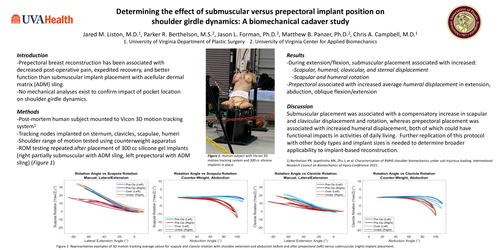
-Post-mortem human subject mounted to Vicon 3D motion tracking system1
-Tracking nodes implanted on sternum, clavicles, scapulae, humeri
-Shoulder range of motion tested using counterweight apparatus
-ROM testing repeated after placement of 300 cc silicone gel implants (right partially submuscular with ADM sling, left prepectoral with ADM sling) (Figure 1)
Results
-During extension/flexion, submuscular placement associated with increased:
-Scapular, humeral, clavicular, and sternal displacement
-Scapular and humeral rotation
-Prepectoral associated with increased average humeral displacement in extension, abduction, oblique flexion/extension
Discussion
Submuscular placement was associated with a compensatory increase in scapular and clavicular displacement and rotation, whereas prepectoral placement was associated with increased humeral displacement, both of which could have functional impacts in activities of daily living. Further replication of this protocol with other body types and implant sizes is needed to determine broader applicability to implant-based reconstruction.