212 posters, 10 topics, 5 sessions, 754 authors, 237 institutions
ePostersLive by SciGen Technologies S.A. All rights reserved.
The AAPS 101st Annual Meeting
29 April – 2 May, 2023 | Chicago, IL

D91
Effect Of Pre-pectoral Versus Sub-pectoral Implant Placement In Breast Reconstruction On The Delivery Of Post-mastectomy Radiation
Poster Presenter
Authors
Affiliations
Part of Topic
Breast Reconstruction
•After mastectomy for breast cancer, more than 40% of women will have breast reconstruction1
•There has been increasing interest in using pre-pectoral rather than sub-pectoral (Figure 1) implants given the lower rates of deformity, pain and healing time post-surgery.2
•However, many women who undergo reconstruction also receive adjuvant radiation therapy, and the impact of pre-pectoral implants vs sub-pectoral implants on radiation plan quality remains unknown
•We aimed to evaluate the impact of pre-pectoral versus sub-pectoral implants on radiation dosimetry
•Retrospective chart review of patients who had implant-based reconstruction or tissue expander placement (either pre-pectoral or sub-pectoral implants) followed by post-mastectomy radiation (PMRT), treated at a single institution between 2014-2022.
•Matching 1:1 between patients receiving sub-pectoral or pre-pectoral reconstruction based on the following criteria:
•Cancer sidedness (left vs right)
•Use of boost (yes vs no)
•Fractionation (conventional vs hypofractionation)
•Extent of radiation fields (chest wall only vs chest wall and regional nodal irradiation)
•Used Mann-Whitney U test to compare DVH metrics including mean heart dose, ipsilateral lung V20Gy, internal mammary node (IMN) D80%, and chest wall (CW) D95%
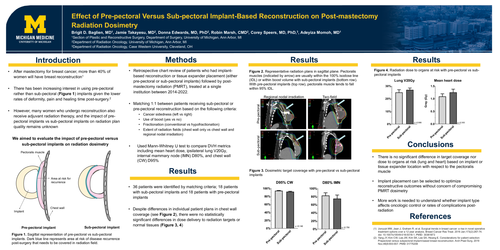
•36 patients were identified by matching criteria; 18 patients with sub-pectoral implants and 18 patients with pre-pectoral implants
•Despite differences in individual patient plans in chest wall coverage (see Figure 2), there were no statistically significant differences in dose delivery to radiation targets or normal tissues (Figure 3, 4)
•There is no significant difference in target coverage nor dose to organs at risk (lung and heart) based on implant or tissue expander location with respect to the pectoralis muscle
•Implant placement can be selected to optimize reconstructive outcomes without concern of compromising PMRT dosimetry
•More work is needed to understand whether implant type affects oncologic control or rates of complications post-radiation
References
(1)Jonczyk MM, Jean J, Graham R, et al. Surgical trends in breast cancer: a rise in novel operative treatment options over a 12 year analysis. Breast Cancer Res Treat. 2019 Jan;173(2):267-74. doi: 10.1007/s10549-018-5018-1. PMID: 30361873
(2)Yang JY, Kim CW, Lee JW, Kim SK, Lee SA, Hwang E. Considerations for patient selection: Prepectoral versus subpectoral implant-based breast reconstruction. Arch Plast Surg. 2019 Nov;46(6:550-557. PMID 31775208