Loading...

212 posters, 10 topics, 5 sessions, 754 authors, 237 institutions

ePostersLive by SciGen Technologies S.A. All rights reserved.

The AAPS 101st Annual Meeting

29 April – 2 May, 2023 | Chicago, IL

The AAPS 101st Annual Meeting banner

D89

Utilizing The Mother Infant Lactation Questionnaire To Assess Breastfeeding Success After Benign Breast Surgery
Poster Presenter

Ashley Gordon

Part of Topic

Breast Reconstruction

Utilizing the Mother Infant Lactation Questionnaire to Assess Breastfeeding Success after Benign Breast Surgery

Ashley M. Gordon, BA; Shannon M. Malloy, BS; Ava G. White, BA; Rachel R. Watson, BA; Laura C. Nuzzi, BA; Joseph M. Firriolo, MD; Catherine T. McNamara, BS; Brian I. Labow, MD

Department of Plastic and Oral Surgery, Boston Children’s Hospital, Harvard Medical School 

BACKGROUND 

•Breastfeeding has many health benefits for both maternal and child health.
•The World Health Organization recommends exclusively breastfeeding for the first 6 months of life; however most Americans do not meet this goal.
•Many young patients refrain from undergoing benign breast surgery for fear of impacting  breastfeeding future ability.
•Study aim: To compare breastfeeding and lactation outcomes amongst cohorts of mothers who had a reduction or augmentation mammoplasty prior to pregnancy and controls
 
METHODS 
ASSESSMENT TOOL: 
•Mother Infant Lactation Questionnaire (MILQ)©, a multidomain patient-reported outcome measure to assess breastfeeding and lactation. Copyright ©️ 2023 Boston Children’s Hospital. All Rights Reserved.
 
INCLUSION CRITERIA 
•18 to 45 years old at time of survey
•English-speaking adult mothers
•Between 6 months and 5 years postpartum
 
 
BREASTFEEDING OUTCOMES 

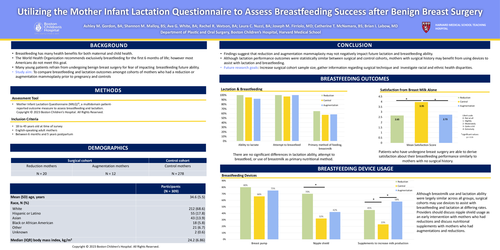
There are no significant differences in lactation ability, attempt to breastfeed, or use of breastmilk as primary nutritional method.

Patients who have undergone breast surgery are able to derive satisfaction about their breastfeeding performance similarly to mothers with no surgical history.

BREASTFEEDING DEVICE USAGE 

Although breastmilk use and lactation ability were largely similar across all groups, surgical cohorts may use devices to assist with breastfeeding and lactation at differing rates. Providers should discuss nipple shield usage as an early intervention with mothers who had reductions and discuss nutritional supplements with mothers who had augmentations and reductions.


CONCLUSION
 
•Findings suggest that reduction and augmentation mammaplasty may not negatively impact future lactation and breastfeeding ability.
•Although lactation performance outcomes were statistically similar between surgical and control cohorts, mothers with surgical history may benefit from using devices to assist with lactation and breastfeeding.
•Future research goals: Increase surgical cohort sample size, gather information regarding surgical technique and  investigate racial and ethnic health disparities.
The AAPS 101st Annual Meeting » banner
Copyright © 2015-2026, ePostersLive® SciGen is a registered trademark of SciGen Technologies S.A. Patent pending.

This website and third-party tools we use rely on cookies for the best user experience. By selecting "I agree", you agree to cookie usage as described in our Privacy Policy.