212 posters, 10 topics, 5 sessions, 754 authors, 237 institutions
ePostersLive by SciGen Technologies S.A. All rights reserved.
The AAPS 101st Annual Meeting
29 April – 2 May, 2023 | Chicago, IL

D83
Watching Your Back: The Effect Of Muscle Flap Coverage On Outcomes And Resource Utilization Following Posterior Spinal Fusions
Poster Presenter
Authors
Grant Black, Makayla Kochheiser, Yunchan Chen, Matthew Wright, Ali Jalali, David Otterburn
Affiliations
Part of Topic
General Reconstruction
Watching Your Back: The Effect of Muscle Flap Coverage on Outcomes and Resource Utilization Following Posterior Spinal Fusions
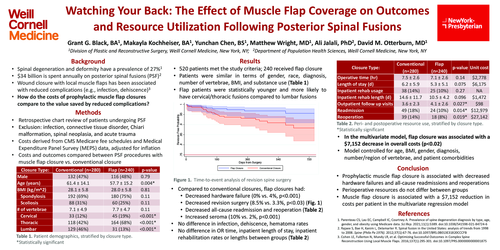
Background: Spinal degeneration and deformities have a prevalence of over 27% in US adults, and $34 billion is spent annually on spinal fusion to address these pathologies. Wound closure after fusion using local muscle flaps has been associated with reduced rates of complications, including infection and reoperation. The high prevalence of degenerative deformities and subsequent healthcare expenditures highlight the need for resource utilization studies to inform decision-makers on best operative practices.
Methods: A retrospective review was performed on adult patients at our institution who underwent posterior spinal fusion due to degenerative or deforming changes between 2019 and 2022. Patients were stratified by the prophylactic use of muscle flap closure, and outcomes were compared between groups. Costs were applied to consumed resources, and univariate and multivariate regressions were performed to measure the impact of muscle flaps on overall costs.
Results: 520 patients were included; 240 received muscle flap closures. These patients had significantly fewer readmissions (OR 0.52, p<0.02), reoperations (OR 0.50, p<0.02), and hardware failures (OR 0.10, p<0.01), but did experience greater incidence of seroma (OR 6.11, p<0.01). Operative time and hospital length of stay did not vary by closure type. In the multivariate regression, muscle flap closure was associated with a $7,152 reduction in overall costs per patient (p<0.03).
Conclusions: Muscle flap closure correlates with reduced complication rates while also leading to decreased overall costs per patient. These findings support the use of prophylactic muscle flap closure from patient safety and health economics perspectives.