212 posters, 10 topics, 5 sessions, 754 authors, 237 institutions
ePostersLive by SciGen Technologies S.A. All rights reserved.
The AAPS 101st Annual Meeting
29 April – 2 May, 2023 | Chicago, IL

D79
School-age Anthropometric And Cognitive Outcomes In Sagittal Craniosynostosis
Poster Presenter
Authors
Affiliations
Part of Topic
Craniofacial/Peds
School-Age Anthropometric And Cognitive Outcomes In Sagittal Craniosynostosis
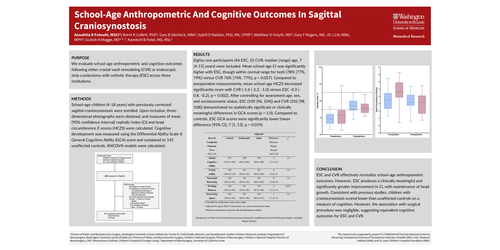
PURPOSE: We evaluate school-age anthropometric and cognitive outcomes following either cranial vault remodeling (CVR) or endoscopic strip craniectomy with orthotic therapy (ESC) across three institutions.
METHODS: School-age children (4-18 years) with previously corrected sagittal craniosynostosis were enrolled. Upon inclusion, threedimensional photographs were obtained, and measures of mean [95% confidence interval] cephalic index (CI) and head circumference Z-scores (HCZS) were calculated. Cognitive development was measured using the Differential Ability Scale-II General Cognitive Ability (GCA) score and compared to 141 unaffected controls. ANCOVA models were calculated.
RESULTS: Eighty-one participants (46 ESC, 35 CVR; median [range] age, 7 [4-15] years) were included. Mean school-age CI was significantly higher with ESC, though within normal range for both (78% [77%, 79%] versus CVR 76% [74%, 77%]; p = 0.027). Compared to preoperative measurements, mean school-age HCZS decreased significantly more with CVR (-1.6 [-2.2, -1.0] versus ESC -0.3 [-0.8, -0.2]; p = 0.002). After controlling for assessment age, sex, and socioeconomic status, ESC (100 [96, 104]) and CVR (103 [98, 108]) demonstrated no statistically significant or clinically meaningful differences in GCA scores (p = 1.0). Compared to controls, ESC GCA scores were significantly lower (mean difference [95% CI], 7 [1, 13], p = 0.019).
CONCLUSION: ESC and CVR effectively normalize school-age anthropometric outcomes. However, ESC produces a clinically meaningful and significantly greater improvement in CI, with maintenance of head growth. Consistent with previous studies, children with craniosynostosis scored lower than unaffected controls on a measure of cognition. However, the association with surgical procedure was negligible, suggesting equivalent cognitive outcomes for ESC and CVR.