212 posters, 10 topics, 5 sessions, 754 authors, 237 institutions
ePostersLive by SciGen Technologies S.A. All rights reserved.
The AAPS 101st Annual Meeting
29 April – 2 May, 2023 | Chicago, IL

D74
A Novel Algorithm For Pediatric Microsurgical Maxillomandibular Reconstruction Using Custom Endoprosthesis
Poster Presenter
Authors
Collean Trotter, BA, MAT, Devon O'Brien, Dylan Choi, Sarah Alfeerawi, Idean Roohani, Pasha Shakoori, Ja Shen Lo, Kevin Chen, Mark M. Urata, Jessica A. Lee, Jeffrey A. Hammoudeh
Affiliations
Division of Plastic and Maxillofacial Surgery, Children’s Hospital Los Angeles, Division of Plastic and Reconstructive Surgery, Keck School of Medicine, Keck School of Medicine of the University of Southern California
Part of Topic
Craniofacial/Peds
|
A Novel Algorithm for Pediatric Microsurgical Maxillomandibular Reconstruction Using Custom Endoprosthesis |
|
Collean Trotter, BA, MAT; Devon O’Brien, BS; Dylan Choi, BS; Sarah Alfeerawi, BS, MS; Idean Roohani, BS; Pasha Shakoori, MD, DDS, MA; Ja-Shen Lo, BS; Kevin Chen, MD; Mark M. Urata, MD, DDS;Jessica A. Lee, MD; Jeffrey A. Hammoudeh, MD, DDS Background ● With a critical role in mastication, speech, and facial contour, reconstruction following resection of maxillary and mandibular tumors pose distinct challenges for microsurgeonsn ● In pediatrics, jaw reconstruction is further complexed by the need to preserve growth potential, optimize functionality of the upper and lower jaw, and facilitate future dental restoration ● Current reconstruction options include Non-Custom Plates (NCP) and Custom Endoprosthesis (CE) in conjunction with vascularized free flaps ● Literature lacks a predictable treatment algorithm for reconstruction of the pediatric maxilla and mandible
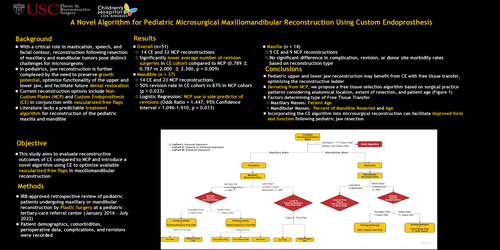
Objective ● This study aims to evaluate reconstructive outcomes of CE compared to NCP and introduce a novel algorithm using CE to optimize available vascularized free flaps in maxillomandibular reconstruction Methods ● IRB-approved retrospective review of pediatric patients undergoing maxillary or mandibular reconstruction by Plastic Surgery at a pediatric tertiary- care referral center (January 2016 - July 2022) ● Patient demographics, comorbidities, perioperative data, complications, and revisions were recorded Results ● Overall (n=51) ● Mandible (n = 37) ●14 CE and 23 NCP reconstructions ● Maxilla (n = 14) ○ 5 CE and 9 NCP reconstructions Conclusions ● Pediatric upper and lower jaw reconstruction may benefit from CE with free tissue transfer, optimizing the reconstructive ladder ● Deviating from NCP, we propose a free tissue selection algorithm based on surgical practice patterns considering anatomical location, extent of resection, and patient age (Figure 1) ● Factors determining type of Free Tissue Transfer ● Incorporating the CE algorithm into microsurgical reconstruction can facilitate improved form and function following pediatric jaw resection
|