212 posters, 10 topics, 5 sessions, 754 authors, 237 institutions
ePostersLive by SciGen Technologies S.A. All rights reserved.
The AAPS 101st Annual Meeting
29 April – 2 May, 2023 | Chicago, IL

D65
Optimizing The Design Of Biodegradable 3d-printed Scaffolds For Tissue Engineering Nipples With Lasting Projection And Biosimilar Stiffness
Poster Presenter
Authors
Xue Dong, Timothy Butler, George Corpuz, Gillian O’Connell, Hector Salazar, Skander Limem, Jason Spector
Affiliations
Part of Topic
Breast Reconstruction
PURPOSE: Creating the nipple is the last surgical step of breast reconstruction. However, autologous tissue techniques are limited due to
scar contracture and significant loss of neo-nipple projection. Poly-4-Hydroxybutyrate (P4HB) is a biodegradable polymer with a long track
record of clinical use as a surgical mesh and we have previously shown long-term maintenance of nipple projection using 3D-printed P4HB
nipple scaffolds filled with processed cartilage in nude rats. Here we aim to modify the interior reticular structure of the 3D-printed P4HB
cylindrical scaffold to better mimic the biomechanical properties of the native nipple while maintaining the nipple projection in an
immunocompetent rodent model.
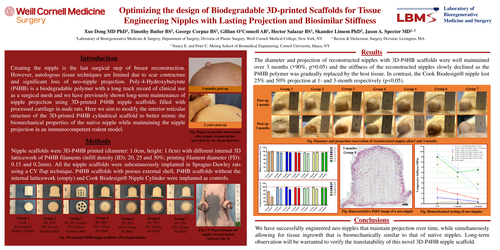
METHODS: Nipple scaffolds were 3D-P4HB printed (diameter: 1.0cm, height: 1.0cm) with different internal 3D latticework of P4HB filaments
(infill density: 20, 25 and 30%; filament diameter: 0.15 and 0.2mm). All the scaffolds were subcutaneously implanted in rats using a CV flap
technique. P4HB scaffolds without the internal latticework and Cook Biodesign® Nipple Cylinder were implanted as controls.
RESULTS: The projection of 3D-P4HB nipples were well maintained over 3 months (>90%, p>0.05) and nipple stiffness slowly declined as
the polymer was gradually replaced by tissue. In contrast, the Cook Biodesign® nipple lost 25% and 50% projection at 1- and 3-month
respectively (p<0.05).
CONCLUSION: We have successfully engineered neo-nipples that maintain projection over time, while simultaneously allowing for tissue
ingrowth that is biomechanically similar to that of native nipples. Long-term observation will be warranted to verify the translatability of this
novel 3D-P4HB nipple scaffold.