212 posters, 10 topics, 5 sessions, 754 authors, 237 institutions
ePostersLive by SciGen Technologies S.A. All rights reserved.
The AAPS 101st Annual Meeting
29 April – 2 May, 2023 | Chicago, IL

D53
Risk Stratification Of Transcranial Midface Advancement In Patients With Syndromic Craniosynostosis: 20-year Institutional Experience
Poster Presenter
Part of Topic
Craniofacial/Peds
Background
•Transcranial midface advancement can have profound benefits for patients with syndromic craniosynostosis, but is associated with high morbidity
•Our institution has adopted posterior vault distraction osteogenesis (PVDO) as a first-line intervention for cranial expansion in these patients
•As a result of vault expansion from PVDO, many patients have undergone transcranial midface advancement without a prior frontal vault surgery
•It is possible that midface advancement in the setting of decreased scarring and dural adhesions favorably influences the risk profile of these operations
Objectives
•Compare perioperative outcomes in patients undergoing transcranial midface advancement with and without history of prior frontal vault remodeling (FOAR)
Methods
•Retrospective review of patients undergoing transcranial midface advancement from 2000-2022
•Patients divided into two cohorts (FOA-, FOA+)
•Perioperative outcomes (operative duration, blood loss, LOS, and complications (Clavien-Dindo) compared between groups
Results
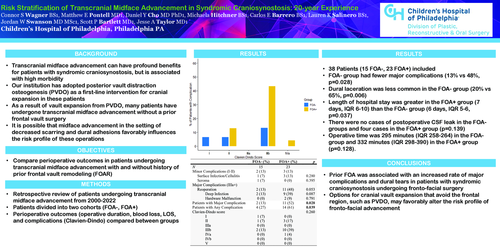
•38 Patients (15 FOA-, 23 FOA+) included
•FOA- group had fewer major complications (13% vs 48%, p=0.028)
•Dural laceration was less common in the FOA- group (20% vs 65%, p=0.006)
•Length of hospital stay was greater in the FOA+ group (7 days, IQR 6-10) than the FOA- group (6 days, IQR 5-6, p=0.037)
•There were no cases of postoperative CSF leak in the FOA- groups and four cases in the FOA+ group (p=0.139)
•Operative time was 295 minutes (IQR 258-264) in the FOA- group and 332 minutes (IQR 298-390) in the FOA+ group (p=0.128).
Conclusions
•Prior FOA was associated with an increased rate of major complications and dural tears in patients with syndromic craniosynostosis undergoing fronto-facial surgery
•Options for cranial vault expansion that avoid the frontal region, such as PVDO, may favorably alter the risk profile of fronto-facial advancement