212 posters, 10 topics, 5 sessions, 754 authors, 237 institutions
ePostersLive by SciGen Technologies S.A. All rights reserved.
The AAPS 101st Annual Meeting
29 April – 2 May, 2023 | Chicago, IL

D51
A Comparative Photogrammetric Assessment Of Soft Tissue Changes Following LeFort III And Monobloc Midface Advancement
Poster Presenter
Part of Topic
Craniofacial/Peds
Background
•The LeFort III and monobloc are commonly employed midface advancement procedures for patients with syndromic craniosynostosis
•Osteotomy choice is typically guided by phenotypic severity and functionals needs
•While the postoperative skeletal changes are well characterized, objective assessments of overlying soft tissues changes are lacking despite their contribution towards aesthetic outcomes.
Objectives
•Develop a set of soft tissue measurements applicable to standard clinical photographs which quantify soft tissue changes after LeFort III and monobloc surgery
•Compare the soft tissue effects of LeFort III versus monobloc using this methodology
Methods
•Retrospective review of patients with syndromic craniosynostosis undergoing primary midface advancement
•ImageJ used to compare frontal and lateral pre- and postoperative photographs
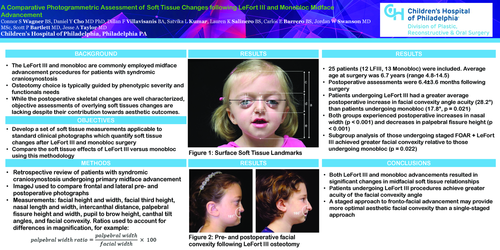
•Measurements: facial height and width, facial third height, nasal length and width, intercanthal distance, palpebral fissure height and width, pupil to brow height, canthal tilt angles, and facial convexity. Ratios used to account for differences in magnification, for example:
Results
•25 patients (12 LFIII, 13 Monobloc) were included. Average age at surgery was 6.7 years (range 4.8-14.5)
•Postoperative assessments were 6.4±3.6 months following surgery
•Patients undergoing LeFort III had a greater average postoperative increase in facial convexity angle acuity (28.2°) than patients undergoing monobloc (17.8°, p = 0.021)
•Both groups experienced postoperative increases in nasal width (p < 0.001) and decreases in palpebral fissure height (p < 0.001)
•Subgroup analysis of those undergoing staged FOAR + LeFort III achieved greater facial convexity relative to those undergoing monobloc (p = 0.022)
Conclusions
•Both LeFort III and monobloc advancements resulted in significant changes in midfacial soft tissue relationships
•Patients undergoing LeFort III procedures achieve greater acuity of the facial convexity angle
•A staged approach to fronto-facial advancement may provide more optimal aesthetic facial convexity than a single-staged approach