212 posters, 10 topics, 5 sessions, 754 authors, 237 institutions
ePostersLive by SciGen Technologies S.A. All rights reserved.
The AAPS 101st Annual Meeting
29 April – 2 May, 2023 | Chicago, IL

PC11
Proposed Protocol For Optimization Of High Risk Lymphedema Resections
Poster Presenter
Authors
Affiliations
Part of Topic
General Reconstruction
Proposed Protocol For Optimization Of High Risk Lymphedema Resections
Callie Horn, MD, John C. Lantis II, MD
Icahn School of Medicine at Mount Sinai, New York, NY, USA
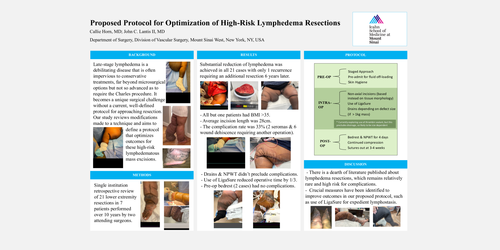
PURPOSE: Late stage lymphedema is a debilitating disease that is often impervious to conservative treatments, far beyond microsurgical options but not so advanced as to require the Charles procedure, and becomes a unique surgical challenge without a current, well-defined protocol for approaching resection. Our study reviews modifications made to a technique developed over a decade and aims to define a protocol that optimizes outcomes for these high risk lymphedematous mass excisions.
METHODS: Single institution retrospective review of 21 lower extremity resections in 7 patients performed over 10 years by two surgeons.
RESULTS: Substantial reduction of lymphedema was achieved in all 21 cases involving 7 patients with only 1 recurrence requiring an additional resection 6 years later. Average incision length was 28cm. All but one patients had BMI >35. The complication rate was 33% and included 2 seromas and 6 wound dehiscence requiring re-operation. Use of drains and negative pressure wound therapy was consistent, but did not preclude complications. Use of Ligasure device reduced operative time by 1/3. Two cases admitted for pre-operative bedrest had no complications.
CONCLUSION: Overall there is not significant literature published about lymphedema resections and this relatively rare type of surgery remains high risk for complications. Crucial measures have been identified to improve outcomes such as a staged approach, pre-admitting for offloading and fluid management, use of Ligasure for expedient lymphostasis, drains, postoperative bedrest with negative pressure therapy, and continue compression as outpatient. Our group presents this case series and a protocol for optimization.