171 posters, 10 topics, 5 sessions, 690 authors, 211 institutions
ePostersLive by SciGen Technologies S.A. All rights reserved.
American Association of Plastic Surgeons Meeting 2022
April 9 - 12 | San Diego, California

P60
Patient Factors That Affect Pre-operative Patient Reported Outcomes In Women Undergoing Breast Cancer Surgery
Poster Presenter
Authors
Wing Lee Cheung, Cara Cannella, Yalei Chen, Sanjay Rama, Semar Yono, Isabela Romano, Jessica Bensenhaver, Daniel Yoho, Dunya Atisha
Affiliations
Department of Surgery, Henry Ford Health System, Detroit, Michigan, Department of Public Health Sciences, Henry Ford Health System, Detroit, Michigan, Department of Plastic Surgery, Henry Ford Health System, Detroit, Michigan
Part of Topic
Breast Reconstruction
Patient Factors That Affect Pre-Operative Patient Reported Outcomes in Women Undergoing Breast Cancer Surgery
Introduction
Understanding the impact of patient, disease, and treatment factors on pre-operative patient reported outcomes (PROs) is important to guide surgical decision-making with breast cancer.
Methods
This prospective cohort study evaluates PROs in women undergoing breast cancer treatment at a metropolitan health care system. New cases undergo tumor board discussion and same-day consultations with various specialties. Women choose to complete pre- and post-operative Breast-Q© Breast Conserving Surgery(BCS), Mastectomy(M), or Reconstruction(R) modules and demographic surveys. Individual associations to pre-operative Breast-Q survey scores were assessed using linear regression models (one for each Breast-Q survey type). Variables significant for at least one survey were included in multiple linear regression models.
Results
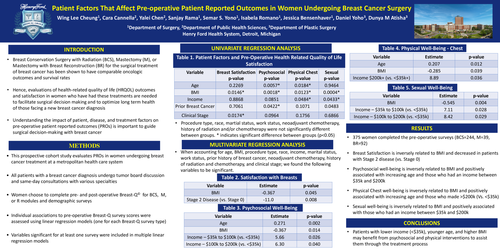
375 women completed the pre-operative surveys (BCS=244, M=39, BR=92). Procedure choice, laterality, race, marital status, employment, prior breast cancer, neoadjuvant chemotherapy, or history of radiation or chemotherapy did not impact PROs. Breast satisfaction decreased with higher BMI (est=-0.367, p=0.045) and stage 2 disease (est=-11.011 (vs. stage 0), p=0.008). Lower psychosocial score was associated with younger age (est=0.271, p=0.002), higher BMI (est=-0.367, p=0.014), and income <35k (est=-5.81 (vs. 35k+), p=0.016). Similarly, lower physical well-being of the chest was associated with younger age (est=0.207, p=0.011), higher BMI (est=-0.285, p=0.039), and income <35k (est=-4.58 (vs. 35k+, p=0.039). Sexual well-being decreased with higher BMI (est=-0.545, p=0.004) and income <35k (est=0.135 (vs. 35k+), p=0.016).
Conclusion
While factors such as age, BMI, and stage of disease are difficult to change prior to surgery, patients with lower income may need special interventions to assist them through the treatment process.