171 posters, 10 topics, 5 sessions, 690 authors, 211 institutions
ePostersLive by SciGen Technologies S.A. All rights reserved.
American Association of Plastic Surgeons Meeting 2022
April 9 - 12 | San Diego, California

P38
Therapeutic Vs. Prophylactic Bilateral Mastectomies: Complications And Trends In The United States
Poster Presenter
Part of Topic
Breast Reconstruction
Therapeutic vs. Prophylactic Bilateral Mastectomies: Complications and Trends in the United States
Authors: Mohammed Shaheen, JD and Arash Momeni, MD, FACS
Affiliation: Division of Plastic & Reconstructive Surgery, Stanford University School of Medicine
Introduction
•Unilateral breast cancer (UBC) patients are increasingly undergoing contralateral prophylactic mastectomy (CPM) despite decreasing rates of contralateral breast cancer and poorly understood risks of prophylactic mastectomy.
•Due to the “Jolie Effect” and other media focus on prophylactic treatments, UBC patients may be opting for CPM based on outcomes of patients undergoing bilateral mastectomy (BM) purely prophylactically.
Objectives/Aims
•Compare complication rates of UBC patients undergoing CPM (BM-TP) to patients undergoing bilateral prophylactic mastectomy (BM-P)
•Assess 2015-2019 CPM trends among UBC patients in the United States
Methods
•Optum Clinformatics® DataMart was used to identify BM-TP and BM-P patients who underwent BM from 2015-2019.
•Six-month outcomes were assessed and included wound complications, infection, hematoma/seroma, breast pain, fat necrosis, flap rejection/failure, implant removal, other flap/implant complications, and other complications.
•Multivariable regression models adjusted for age, state of residence, insurance type, race, and Charlson comorbidity index score.
•Two-tailed p-values <0.05 were considered statistically significant. Statistical analyses were performed using SAS version 9.4 (SAS Institute, Cary, NC).
Results
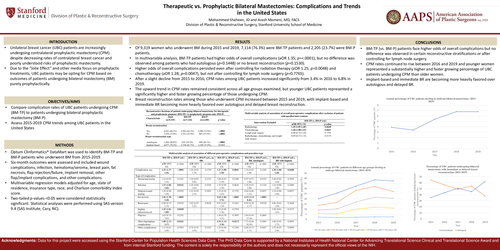
•Of 9,319 women who underwent BM during 2015 and 2019, 7,114 (76.3%) were BM-TP patients and 2,205 (23.7%) were BM-P patients.
•In multivariable analysis, BM-TP patients had higher odds of overall complications (aOR 1.35; p=<.0001), but no difference was observed among patients who had autologous (p=0.1448) or no breast reconstruction (p=0.1530).
•Higher odds of overall complications persisted even after controlling for radiation therapy (aOR 1.25; p=0.0048) and chemotherapy (aOR 1.28; p=0.0047), but not after controlling for lymph node surgery (p=0.7765).
•After a slight decline from 2015 to 2016, CPM rates among UBC patients increased significantly from 3.4% in 2016 to 6.8% in 2019.
•The upward trend in CPM rates remained consistent across all age groups examined, but younger UBC patients represented a significantly higher and faster growing percentage of those undergoing CPM.
•Breast reconstruction rates among those who underwent CPM increased between 2015 and 2019, with implant-based and immediate BR becoming more heavily favored over autologous and delayed breast reconstruction.
Conclusions
•BM-TP (vs. BM-P) patients face higher odds of overall complications but no difference was observed in certain reconstructive stratifications or after controlling for lymph node surgery.
•CPM rates continued to rise between 2016 and 2019 and younger women represented a substantially higher and faster growing percentage of UBC patients undergoing CPM than older women.
•Implant-based and immediate BR are becoming more heavily favored over autologous and delayed BR.