171 posters, 10 topics, 5 sessions, 690 authors, 211 institutions
ePostersLive by SciGen Technologies S.A. All rights reserved.
American Association of Plastic Surgeons Meeting 2022
April 9 - 12 | San Diego, California

P37
The Value Of Process Analysis: A Multivariate Analysis Shows Immediate And Sustained Decrease In Morbidity And Operative Time
Poster Presenter
Authors
Affiliations
Part of Topic
Breast Reconstruction
Deliberate Practice and Process Analysis in DIEP Flap Breast Reconstruction: An Immediate and Sustained Decrease in Morbidity and Operative Time
Nicholas T. Haddock, MD John T. Tycher, BS; Sumeet S. Teotia, MD
Department of Plastic Surgery, University of Texas Southwestern Medical Center, Dallas, TX, US
• Deep inferior epigastric perforator (DIEP) flap is the gold standard for autologous breast reconstruction. • Operative efficiency can be a sensitive barometer for complications, pain, length of stay and aesthetic outcomes. • Various industries and surgical disciplines leverage process mapping and analysis to identify inefficiencies. • Senior authors (N.T.H. and S.S.T.) implemented two prospective process analysis studies and defined steps critical to maximizing safety and efficiency in DIEP flaps.
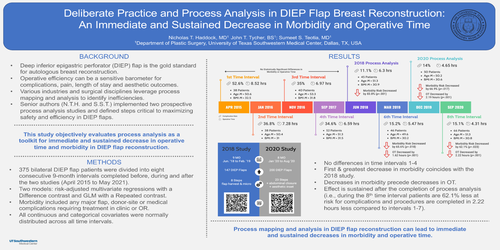
This study objectively evaluates process analysis as a toolkit for immediate and sustained decrease in operative time and morbidity in DIEP flap reconstruction.
• 375 bilateral DIEP flap patients were divided into eight consecutive 9-month intervals completed before, during and after the two studies (April 2015 to May 2021). • Two models: risk-adjusted multivariate regressions with a Difference contrast and GLM with a Repeated contrast. • Morbidity included any major flap, donor-site or medical complications requiring treatment in clinic or OR. • All continuous and categorical covariates were normally distributed across all time intervals.
• No differences in time intervals 1-4 • First & greatest decrease in morbidity coincides with the 2018 study. • Decreases in morbidity precede decreases in OT. • Effect is sustained after the completion of process analysis (i.e., during the 8th time interval patients are 62.1% less at risk for complications and procedures are completed in 2.22 hours less compared to intervals 1-7).