171 posters, 10 topics, 5 sessions, 690 authors, 211 institutions
ePostersLive by SciGen Technologies S.A. All rights reserved.
American Association of Plastic Surgeons Meeting 2022
April 9 - 12 | San Diego, California

P57
Total Breast Reconstruction With Reverse Expansion (RE) And Autologous Fat Transfer (AFT): Single Center Experience With 2000 Breasts
Poster Presenter
Authors
Affiliations
Part of Topic
Breast Reconstruction
Total Breast Reconstruction with Autologous Fat Transfer (AFT) & Expansion Reversal (ER):
Single Center Experience with 2000 Consecutive Breasts Reconstructed with the AFTER Procedure
Roger K Khouri, MD, FACS; Daniel Calva-Cerqueira, MD, FACS; Raul A Cortes, MD, FACS
Miami Breast Center
Introduction
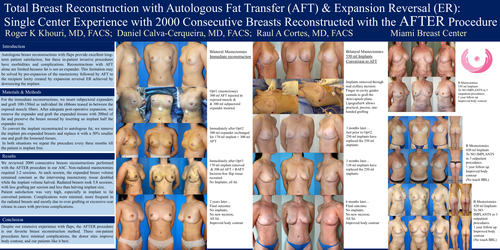
Autologous breast reconstructions with flaps provide excellent long-term patient satisfaction, but these in-patient invasive procedures have morbidities and complications. Reconstructions with AFT alone are limited because fat is not an expander. This limitation may be solved by pre-expansion of the mastectomy followed by AFT to the recipient laxity created by expansion reversal ER achieved by downsizing the implant.
Materials & Methods
For the immediate reconstructions, we insert subpectoral expanders and graft 100-150ml as individual fat ribbons teased in-between the exposed muscle fibers. After adequate post-operative expansion, we remove the expander and graft the expanded tissues with 200ml of fat and preserve the breast mound by inserting an implant half the expander size.
To convert the implant reconstructed to autologous fat, we remove the implant pre-expanded breasts and replace it with a 50% smaller one and graft the loosened tissues.
Results
In both situations, we repeat the procedure every three months till the patient is implant free.
We reviewed 2000 consecutive breasts reconstructions performed with the AFTER procedure in our ASC. Non-radiated mastectomies required 3.2 sessions. At each session, the expanded breast volume remained constant as the intervening mastectomy tissue doubled while the implant volume halved. Radiated breasts took 5.8 sessions, with less grafting per session and less than halving implant size.
Patient satisfaction was very high, especially in implant to fat converted patients. Complications were minimal, more frequent in the radiated breasts and mostly due to over grafting or excessive scar release in cases with previous complications.
Conclusion
Despite our extensive experience with flaps, the AFTER procedure is our favorite breast reconstruction method. These out-patient procedures have minimal complications, the donor sites improve body contour, and our patients like it best.