171 posters, 10 topics, 5 sessions, 690 authors, 211 institutions
ePostersLive by SciGen Technologies S.A. All rights reserved.
American Association of Plastic Surgeons Meeting 2022
April 9 - 12 | San Diego, California

P56
Factors Associated With Implant Flipping In Immediate Breast Reconstruction
Poster Presenter
Part of Topic
Breast Reconstruction
Factors Associated with Implant Flipping in Immediate Breast Reconstruction
Kayla E. Leibl, MD; Lyahn K. Hwang, MD; Cassidy Anderson, BS; Katie E. Weichman, MD
Montefiore Medical Center and Albert Einstein University, Division of Plastic and Reconstructive Surgery, Bronx, NY
Introduction
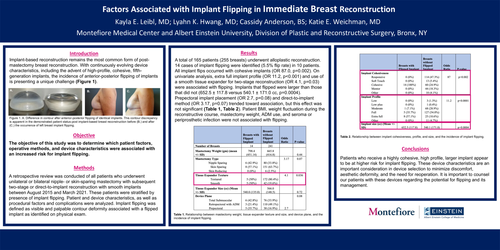
Implant-based reconstruction remains the most common form of post-mastectomy breast reconstruction. With continuously evolving device characteristics, including the advent of high-profile, cohesive, fifth-generation implants, the incidence of anterior-posterior flipping of implants is presenting a unique challenge (Figure 1).
Objective
The objective of this study was to determine which patient factors, operative methods, and device characteristics were associated with an increased risk for implant flipping.
Methods
A retrospective review was conducted of all patients who underwent unilateral or bilateral nipple- or skin-sparing mastectomy with subsequent two-stage or direct-to-implant reconstruction with smooth implants between August 2015 and March 2021. These patients were stratified by presence of implant flipping. Patient and device characteristics, as well as procedural factors and complications were analyzed. Implant flipping was defined as visible and palpable contour deformity associated with a flipped implant as identified on physical exam.
Results
A total of 165 patients (255 breasts) underwent alloplastic reconstruction. 14 cases of implant flipping were identified (5.5% flip rate) in 10 patients. All implant flips occurred with cohesive implants (OR 87.0, p=0.002). On univariate analysis, extra full implant profile (OR 11.2, p<0.001) and use of a smooth tissue expander for two-stage reconstruction (OR 4.1, p=0.03) were associated with flipping. Implants that flipped were larger than those that did not (652.5 ± 117.8 versus 540.1 ± 171.0 cc, p=0.0004). Prepectoral implant placement (OR 2.7, p=0.08) and direct-to-implant method (OR 3.17, p=0.07) trended toward association, but this effect was not significant (Table 1, Table 2). Patient BMI, weight fluctuation during the reconstructive course, mastectomy weight, ADM use, and seroma or periprosthetic infection were not associated with flipping.
Conclusions
Patients who receive a highly cohesive, high profile, larger implant appear to be at higher risk for implant flipping. These device characteristics are an important consideration in device selection to minimize discomfort, aesthetic deformity, and the need for reoperation. It is important to counsel our patients with these devices regarding the potential for flipping and its management.