171 posters, 10 topics, 5 sessions, 690 authors, 211 institutions
ePostersLive by SciGen Technologies S.A. All rights reserved.
American Association of Plastic Surgeons Meeting 2022
April 9 - 12 | San Diego, California

P55
Pregnancy Associated Breast Changes After Nipple Sparing Mastectomy
Part of Topic
Breast Reconstruction
Pregnancy Associated Breast Changes After Nipple Sparing Mastectomy
Kristine C. Paik, BS1, Seth Z. Aschen, MD, MBA2, Alexander Swistel, MD3,Mia Talmor, MD2
1 Weill Cornell Medical College, 2 Division of Plastic and Reconstructive Surgery, Weill Cornell Medicine, 3 Division of Breast Surgery, Weill Cornell Medicine
Introduction:
• Increasing numbers of women are having children after
mastectomy, and 37% of patients diagnosed with breast
cancer and of reproductive age report wanting to have
children after completing treatment1.
• While nipple sparing mastectomy (NSM) has been shown to
have superior cosmetic results with good oncologic safety,
few data evaluate what breast exam changes women can
normally expect during a post NSM pregnancy.
• Patients often assume that since their breast tissue has
been removed, any subsequent breast changes are related
to the reconstruction. Therefore, plastic surgeons are often
the first physician consulted to evaluate physical changes
after reconstruction.
• We present our experience with patients who became
pregnant after NSM particularly with respect to breast
changes and recurrence risk to determine a pattern of
change a patient might expect to occur in order to better
counsel them with respect to further work-up, potential
treatment, and follow-up.
1 Ruddy KJ, et al. Journal of Clinical Oncology 2014;32(11);1151-1156.
Methods:
• Retrospective review of all patients that underwent NSM
and reconstruction by a single plastic surgeon at a large
academic medical center from 2007 to 2020.
• Reproductive age was defined as any patient 45 years of
age or younger at the time of NSM, and patients were
prospectively monitored to identify patients who
subsequently became pregnant.
• Various demographic, operative, tumor, treatment,
reconstructive information, as well as complications, breast
cancer recurrences, presence or absence breast exam
changes in setting of pregnancy after NSM were recorded.
For patients found to have changes on their breast exam in
the setting of pregnancy, the location, description, findings
on imaging, and any associated tissue pathology were
reviewed and documented.
• Analyses were completed using Mann-Whitney tests,
Fisher’s exact tests, and chi-squared analyses. A p-value
<0.05 was considered significant.
Results:
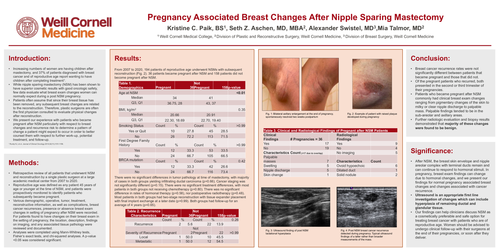
From 2007 to 2020, 194 patients of reproductive age underwent NSMs with subsequent
reconstruction (Fig. 2). 36 patients became pregnant after NSM and 158 patients did not
become pregnant after NSM.
There were no significant differences in tumor pathology at time of mastectomy, with majority
of cases in both groups yielding infiltrating ductal carcinoma (p=0.66). Cancer staging was
not significantly different (p=0.15). There were no significant treatment differences, with most
patients in both groups not receiving chemotherapy (p=0.80). There was no significant
difference in rates of hormonal therapy (p=0.58), nor postoperative radiotherapy (p=0.48).
Most patients in both groups had two-stage reconstruction with tissue expander placement
with final implant exchange at a later date (p>0.99). Both groups had follow-up for an
average of 4 years (p=0.65).
Conclusion:
• Breast cancer recurrence rates were not
significantly different between patients that
became pregnant and those that did not.
• Of the pregnant patients who recurred, both
presented in the second or third trimester of
their pregnancies.
• Patients who became pregnant after NSM
commonly had clinical breast exam changes
ranging from pigmentary changes of the skin to
milky or clear nipple discharge to palpable
mass. Palpable findings tended to be in the
sub-areolar and axillary areas.
• Further radiologic evaluation and biopsy results
demonstrated that majority of these changes
were found to be benign.
Significance:
• After NSM, the breast skin envelope and nipple
areolar complex with terminal ducts remain and
can continue to respond to hormonal stimuli. In
pregnancy, breast exam findings can change
due to hormonal changes, and we present our
findings for normal pregnancy associated breast
changes and changes associated with cancer
recurrence.
• Ultrasound is an appropriate first line
investigation of changes which can include
hyperplasia of remaining ductal and
glandular tissue.
• Our findings can help clinicians discuss NSM as
a cosmetically preferable and safe option for
treating breast cancer with patients who are of
reproductive age. Women should be advised to
undergo clinical follow-up with their surgeons at
the end of their pregnancies, or soon after they
deliver.