171 posters, 10 topics, 5 sessions, 690 authors, 211 institutions
ePostersLive by SciGen Technologies S.A. All rights reserved.
American Association of Plastic Surgeons Meeting 2022
April 9 - 12 | San Diego, California

P52
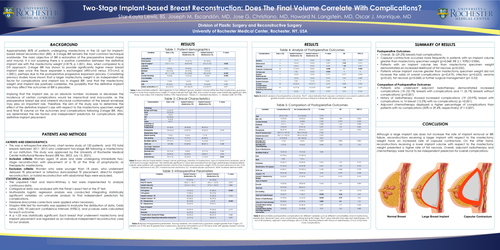
Two-stage Implant-based Breast Reconstruction: Does the Final Volume Correlate with Complications?
Part of Topic
Breast Reconstruction
BACKGROUND: Approximately 80% of patients undergoing mastectomy in the US opt for implant-based breast reconstruction (IBR). A 2-stage IBR remains the most common technique worldwide. The main objective of IBR is restoration of the preoperative breast shape and mound. It is not surprising there is a positive correlation between the definitive implant size with the mastectomy weight (r=81%, p <.001). Also, when compared to a DTI approach, 2-stage IBR has shown to provide significantly higher mean breast implant sizes once the tissue expander is exchanged (490-cm3 versus 373-cm3, p <.0001), perhaps due to the postoperative progressive expansion process. Considering previous studies have shown that a larger mastectomy weight is an independent risk factor for complications and implant loss in staged IBR, and that the mastectomy weight and implant size positively correlates, the possibility that the definitive implant size may affect the outcomes of IBR is plausible.
Implying that the implant size, as an absolute number, increases or decreases the incidence of certain complications would be impractical and inaccurate, as the preoperative breast size and inherent structural conformation of the breast envelope may play an important role. Therefore, the aim of this study was to determine the effect of the definitive implant’s size with respect to the mastectomy specimen weight and final TE volume on the outcomes and complications following 2-stage IBR. Also, we determined the risk factors and independent predictors for complications after definitive implant placement.
PATIENTS AND METHODS: This was a retrospective electronic chart review study of 120 patients and 192 total breasts between 2011- 2015 who underwent two-stage IBR following a mastectomy at our institution. This study was approved by the University of Rochester Medical Center Institutional Review Board (IRB No: 5853, July 13, 2021). Inclusion criteria: Women aged 18 years and older undergoing immediate two-stage reconstruction with placement of a TE at the time of prophylactic or therapeutic mastectomy. Exclusion criteria: Women who were younger than 18 years, who underwent delayed TE placement or latissimus dorsi-assisted TE placement, direct-to implant reconstruction, or hybrid reconstruction with abdominal flaps were excluded.
Statistical Analysis: The unpaired t-test and Mann-Whitney U test were implemented to analyze continuous data. Categorical data were analyzed with the Fisher’s exact test or the X2 test. Multivariate logistic regression analysis was conducted integrating statistically significant variables on univariate analysis to find independent predictors for complications. Haldane-Anscombe corrections were applied when necessary. Shapiro–Wilk test for normality was applied to evaluate the distribution of data. Odds ratios (OR), 95 percent confidence intervals (95%CI), and p-values were calculated for each outcome. A p <.05 was statistically significant. Each breast that underwent mastectomy and implant placement was regarded as an individual independent reconstructive case for our analysis.
RESULTS: Overall, 56 (29.2%) breasts had complications. Capsular contracture occurred more frequently in patients with an implant volume greater than mastectomy specimen weight (p=0.048; RR 2.1; 95%Cl 0.984). Patients with an implant volume less than mastectomy specimen weight demonstrated an increased likelihood of fat necrosis (p=0.032). Patients whose implant volume greater than mastectomy specimen weight did not increase the odds of overall complications (p=0.419), infection (p=0.625), seroma (p=0.65), fat necrosis (p=0.048) or further surgical management (p= 0.32).
Patients who underwent adjuvant radiotherapy demonstrated increased complications (18 (32.1%) breasts with complications and 11 (8.1%) breasts without complications) (p<0.001). History of radiotherapy showed increased complications (19 (33.9%) breast with complications vs 14 breast (12.2%) with no complications) (p <0.001). Adjuvant chemotherapy displayed a higher percentage of complications than patients with no complications (50% vs 29.4%, respectively) (P = 0.007).
CONCLUSION: Although a large implant size does not increase the rate of implant removal or IBR failure, reconstructions receiving a larger implant with respect to the mastectomy weight have an increased rate of capsular contracture. On the other hand, reconstructions receiving a lower implant volume with respect to the mastectomy weight presented a higher rate of fat necrosis. Overall, adjuvant radiotherapy and chemotherapy were found to be independent predictors for overall complications.