171 posters, 10 topics, 5 sessions, 690 authors, 211 institutions
ePostersLive by SciGen Technologies S.A. All rights reserved.
American Association of Plastic Surgeons Meeting 2022
April 9 - 12 | San Diego, California

PC7
Development and Assessment of Artificial Intelligence-Driven Models to Predict Hernia Recurrence, Surgical Complications, and 30-Day Readmission Following Abdominal Wall Reconstruction
Poster Presenter
Part of Topic
Outcomes
Development and Assessment of Artificial Intelligence-Driven Models to Predict Hernia Recurrence, Surgical Complications, and 30-Day Readmission Following Abdominal Wall Reconstruction
Abbas M Hassan, MD; Malke Asaad, MD; Anaeze C Offodile II, MD, MPH, FACS; Charles E Butler, MD, FACSDepartment of Plastic and Reconstructive Surgery, The University of Texas MD Anderson
Cancer Center, Houston, TX.
AWR is common but not without complications
>400,000 operations
performed annually in the US alone.
Costs >$3 billion
Complication rates remain far from acceptable:
Machine learning may improve AWR outcomes
ML: branch of artificial intelligence
ML learns relationships and patterns between complex variables.
ML can identifies patients at high risk of developing complications
Hernia Recurrence
42%
Surgical complications
44%
30-day readmission
13%
Complications following AWR are devastating
*1% reduction in HR alone >$30 million would be saved annually
↓ Quality
of life
↑ Morbidity
↑ Morbidity
↑ Healthcare
Costs*
Model development
80%
N=580
20%
N=145
•Demographics
•Comorbidities
•Preoperative assessment
•Surgical characteristics
New
data
Processed data
Predictive model
Algorithm
Development
ML Predictive Models
Model performance
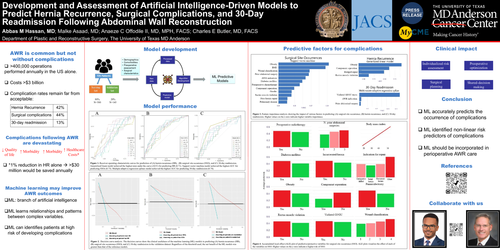
Figure 1. Receiver operating characteristic curves for prediction of (A) hernia recurrence (HR), (B) surgical site occurrence (SSO), and (C) 30-day readmission. Generalized linear model achieved the highest area under the curve (AUC) for predicting HR (0.71). Support vector machine model achieved the highest AUC for predicting SSOs (0.75). Multiple adaptive regression splines model achieved the highest AUC for predicting 30-day readmission (0.74).
A
B
C
Figure 2. Decision curve analysis. The decision curves show the clinical usefulness of the machine learning (ML) models in predicting (A) hernia recurrence (HR), (B) surgical site occurrence (SSO), and (C) 30-day readmission in the validation dataset. Regardless of the threshold used, the net benefit of the ML models was greater than that of the reference models.
A
B
C
Predictive factors for complications
Figure 3. Feature importance analysis showing the impact of various factors in predicting (A) surgical site occurrence, (B) hernia recurrence, and (C) 30-day readmission. Higher values on the x-axis indicate higher variable importance.
Figure 4. Accumulated local effect (ALE) plot of predictive/protective variables for surgical site occurrence (SSO). ALE plots visualizethe effect of each of the variables on SSO. Higher values on the y-axis indicate a higher risk of SSO.
Clinical impact
Individualized risk
assessment
Preoperative
optimization
Surgical
planning
Shared-decision
making
Conclusion
ML accurately predicts the occurrence of complications
ML identified non-linear risk predictors of complications
ML should be incorporated in perioperative AWR care
References
Collaborate with us