171 posters, 10 topics, 5 sessions, 690 authors, 211 institutions
ePostersLive by SciGen Technologies S.A. All rights reserved.
American Association of Plastic Surgeons Meeting 2022
April 9 - 12 | San Diego, California

P146
Incisional Negative Pressure Wound Therapy Is Protective Of Postoperative Cardiothoracic Wound Infection
Part of Topic
Outcomes
Incisional Negative Pressure Wound Therapy is Protective of Postoperative Cardiothoracic Wound Infection
Kaitlin A. Nguyen, BS, George A. Taylor, MD, Theresa K. Webster, BS, Rachel A. Jenkins, BS, Nicklaus S. Houston, BS, Dylan L. Kahler, MD, Andrew A. Gassman, MD, Christine M. Jones, MD
Department of Plastic and Reconstructive Surgery, Temple University, Philadelphia, PA, USA
BACKGROUND
Deep sternal wound infection (DSWI) is a rare but life-threatening
complication of cardiothoracic surgery, with most reported rates between
0.5-2%.
DSWI has a reported mortality rate as high as 30%, with an associated twofold
increase in cost of treatment.
While previously utilized only for the management of open wounds,
negative pressure therapy has been expanded to include application over
closed surgical incisions.
Closed incision negative pressure therapy (ciNPT) is applied
intraoperatively and provides continuous negative pressure at -125mmHg
for 5-7 days.
ciNPT has been associated with positive outcomes of decreased infection
rates and improved postoperative recovery.
OBJECTIVE
Determine whether ciNPT reduced wound infection and improved outcomes
in cardiothoracic surgery, in the largest population of this type studied to
date.
METHODS
A retrospective cohort study was performed including adult patients who
underwent nontraumatic cardiothoracic surgery at a single institution
between 2016-2018 (n=1199).
Subject characteristics were summarized by means and standard
deviations or frequencies and percentages, as applicable.
Significance was determined by independent samples t-tests and χ2 tests
(α = 0.05).
Analysis was completed using SPSS Statistics 26.
RESULTS
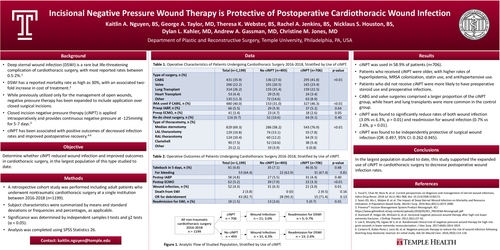
ciNPT was used in 58.9% of patients (n=706).
Patients who received ciNPT were older, with higher rates of
hyperlipidemia, MRSA colonization, statin use, and antihypertensive use.
Patients who did not receive ciNPT were more likely to have preoperative
steroid use and preoperative infections.
CABG and valve surgeries comprised a larger proportion of the ciNPT
group, while heart and lung transplants were more common in the control
group.
ciNPT was found to significantly reduce rates of both wound infection
(3.0% vs 6.3%, p = 0.01) and readmission for wound infection (0.7% vs
2.6%, p = 0.01).
ciNPT was found to be independently protective of surgical wound
infection (OR: 0.497, 95% CI: 0.262-0.945).
CONCLUSIONS
In the largest population studied to date, this study supported the expanded
use of ciNPT in cardiothoracic surgery to decrease postoperative wound
infection rates.