171 posters, 10 topics, 5 sessions, 690 authors, 211 institutions
ePostersLive by SciGen Technologies S.A. All rights reserved.
American Association of Plastic Surgeons Meeting 2022
April 9 - 12 | San Diego, California

P149
Evaluating The Impact Of Breast And Nipple Sensation On Quality-of-Life After Nipple-sparing Mastectomy With Implant Reconstruction: Long-term Outcomes Utilizing BREAST-Q
Poster Presenter
Part of Topic
Outcomes
Evaluating The Impact Of Breast And Nipple Sensation On Quality-of-Life After Nipple-sparing Mastectomy With Implant Reconstruction: Long-term Outcomes Utilizing BREAST-Q
Jacob B. Hammond MD, Lyndsay A. Kandi BS, Valerie L. Armstrong MD, Heidi E. Kosiorek MS, Alanna M. Rebecca MD, MBA, William J. Casey III MD, Erwin A. Kruger MD, Patricia A. Cronin MD, Barbara A. Pockaj MD, Chad M. Teven MD
Mayo Clinic, Phoenix, AZ
Purpose:
The effect of postoperative sensation on quality-of-life (QoL) following nipple-sparing mastectomy (NSM) with implant-based reconstruction is not well-described. We evaluated the impact of breast and nipple sensation on QoL using BREAST-Q.
Methods:
Patients undergoing NSM with implant reconstruction from 2008-2020 were mailed a survey to characterize their postoperative sensation. BREAST-Q metrics were compared between totally numb patients and those with sensation.
Results:
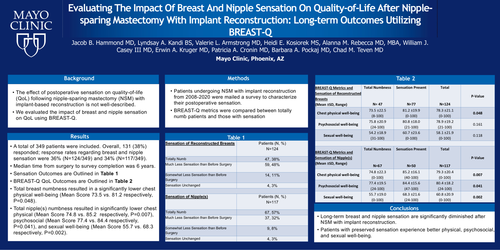
A total of 349 patients were included. Overall, 131 (38%) responded; response rates regarding breast and nipple sensation were 36% (N=124/349) and 34% (N=117/349). Median time from surgery to survey completion was 6 years. The majority had bilateral procedures (101, 77%), including direct-to-implant (99, 76%) and tissue expander (32, 24%) reconstruction. Regarding breast sensation, the majority of patients reported their reconstructed breasts as totally numb (47, 38%) or much less sensation than before surgery (59, 48%). Regarding nipple sensation, the majority of patients reported their nipples were totally numb (67, 57%) or had much less sensation than before surgery (37, 32%). Total numbness of reconstructed breasts resulted in a significantly lower chest physical well-being (Mean Score 73.5 vs. 81.2 respectively, P=0.048,). Total numbness of postoperative nipple(s) resulted in significantly lower chest physical (Mean Score 74.8 vs. 85.2 respectively, P=0.007), psychosocial (Mean Score 77.4 vs. 84.4 respectively, P=0.041), and sexual well-being (Mean Score 55.7 vs. 68.3 respectively, P=0.002).
Conclusions:
Long-term breast and nipple sensation are significantly diminished after NSM with implant reconstruction. Patients with preserved sensation experience better physical, psychosocial, and sexual well-being.