171 posters, 10 topics, 5 sessions, 690 authors, 211 institutions
ePostersLive by SciGen Technologies S.A. All rights reserved.
American Association of Plastic Surgeons Meeting 2022
April 9 - 12 | San Diego, California

P47
Reversal Of Trends In U.S. Breast Surgery Rates: An Analysis From 2005-2017 Using Three Nationwide Datasets
Poster Presenter
Part of Topic
Breast Reconstruction
Reversal Of Trends In U.S. Breast Surgery Rates: An Analysis From 2005-2017 Using Three Nationwide Datasets
Jonas A. Nelson, MD, MPH, Robyn N. Rubenstein, MD, Kathryn Haglich, BS, Jacqueline J. Chu, BA, Carrie S. Stern, MD, Monica Morrow, MD, Audree B. Tadros, MD, MPH, Mary L. Gemignani, MD, MPH, Babak J. Mehrara, MD, Evan Matros, MD, MMSc., MPH.
Memorial Sloan Kettering Cancer Center, New York, NY
Background
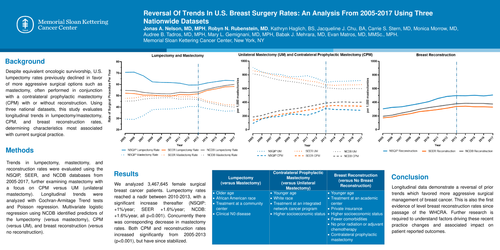
Despite equivalent oncologic survivorship, U.S. lumpectomy rates previously declined in favor of more aggressive surgical options such as mastectomy, often performed in conjunction with a contralateral prophylactic mastectomy (CPM) with or without reconstruction. Using three national datasets, this study evaluates longitudinal trends in lumpectomy/mastectomy, CPM, and breast reconstruction rates, determining characteristics most associated with current surgical practice.
Methods
Trends in lumpectomy, mastectomy, and reconstruction rates were evaluated using the NSQIP, SEER, and NCDB databases from 2005-2017, further examining mastectomy with a focus on CPM versus UM (unilateral mastectomy). Longitudinal trends were analyzed with Cochran-Armitage Trend tests and Poisson regression. Multivariate logistic regression using NCDB identified predictors of the lumpectomy (versus mastectomy), CPM (versus UM), and breast reconstruction (versus no reconstruction).
Results
We analyzed 3,467,645 female surgical breast cancer patients. Lumpectomy rates reached a nadir between 2010-2013, with a significant increase thereafter (NSQIP: +1%/year; SEER +1.6%/year; NCDB: +1.6%/year, all p<0.001). Concurrently there was corresponding decrease in mastectomy rates. Both CPM and reconstruction rates increased significantly from 2005-2013 (p<0.001), but have since stabilized.
Conclusion
Longitudinal data demonstrate a reversal of prior trends which favored more aggressive surgical management of breast cancer. This is also the first evidence of level breast reconstruction rates since passage of the WHCRA. Further research is required to understand factors driving these recent practice changes and associated impact on patient reported outcomes.