171 posters, 10 topics, 5 sessions, 690 authors, 211 institutions
ePostersLive by SciGen Technologies S.A. All rights reserved.
American Association of Plastic Surgeons Meeting 2022
April 9 - 12 | San Diego, California

P43
Acellular Dermal Matrix And Prepectoral Two-stage Breast Reconstruction: A Cohort Analysis Of Alloderm, FlexHD And SurgiMend
Poster Presenter
Authors
Jacqueline Chu, Kathryn Haglich, Robyn Rubenstein, Cayla McKernan, Tajah Bell, Richard Poulton, Carrie Stern, Joseph Disa, Michelle Coriddi, Joseph Dayan, Robert Allen, Jr., Babak Mehrara, Evan Matros, Jonas Nelson
Affiliations
Memorial Sloan Kettering Cancer Center, Memorial Sloan Kettering Cancer
Part of Topic
Breast Reconstruction
Purpose
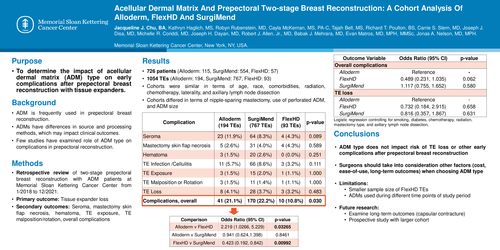
•To determine the impact of acellular dermal matrix (ADM) type on early complications after prepectoral breast reconstruction with tissue expanders.
Background
•ADM is frequently used in prepectoral breast reconstruction.
•ADMs have differences in source and processing methods, which may impact clinical outcomes.
•Few studies have examined role of ADM type on complications in prepectoral reconstruction.
Methods
•Retrospective review of two-stage prepectoral breast reconstruction with ADM patients at Memorial Sloan Kettering Cancer Center from 1/2018 to 12/2021.
•Primary outcome: Tissue expander loss
•Secondary outcomes: Seroma, mastectomy skin flap necrosis, hematoma, TE exposure, TE malposition/rotation, overall complications
Results
•726 patients (Alloderm: 115, SurgiMend: 554, FlexHD: 57)
•1054 TEs (Alloderm: 194, SurgiMend: 767, FlexHD: 93)
•Cohorts were similar in terms of age, race, comorbidities, radiation, chemotherapy, laterality, and axillary lymph node dissection
•Cohorts differed in terms of nipple-sparing mastectomy, use of perforated ADM, and ADM size
Conclusion
•ADM type does not impact risk of TE loss or other early complications after prepectoral breast reconstruction
•Surgeons should take into consideration other factors (cost, ease-of-use, long-term outcomes) when choosing ADM type
•Limitations:
•Smaller sample size of FlexHD TEs
•ADMs used during different time points of study period
•Future research:
•Examine long-term outcomes (capsular contracture)
•Prospective study with larger cohort