171 posters, 10 topics, 5 sessions, 690 authors, 211 institutions
ePostersLive by SciGen Technologies S.A. All rights reserved.
American Association of Plastic Surgeons Meeting 2022
April 9 - 12 | San Diego, California

P31
Control Of The Mineralocorticoid Receptor Enhances Wound Healing And Mitigate Fibrosis After Thermal Injury.
Poster Presenter
Part of Topic
Basic Science Research
Control of the Mineralocorticoid Receptor Enhances Wound Healing and Mitigate Fibrosis After Thermal Injury
Scars remain a majorproblem in care of the burned patient.
The central pathology driving fibrosis is known to be the imbalance of extracellular matrix.
Mineralocorticoid (MR) antagonists have been shown to inhibit inflammation and fibrosis.
Aim: To enhance healing while mitigating hypertrophic collagen deposition after burns in mice with MR antagonists.
Female athymic mice sustained bilateral 1 cm full-thickness thermal injury and were stratified.
Mice were followed with weekly photography for 6weeks.
At the time of sacrifice, samples were collected for H&E, Trichrome, VVG and Pentachrome staining.
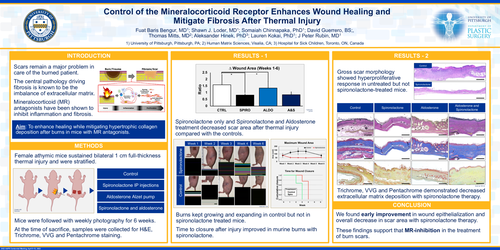
Spironolactone only and Spironolactone and Aldosterone treatment decreased scar area after thermal injury compared with the controls.
Burns kept growing and expanding in control but not in spironolactone treated mice.
Time to closure after injury improved in murine burns with spironolactone.
Gross scar morphology showed hyperproliferative response in untreated but notspironolactone-treated mice.
Trichrome, VVG and Pentachrome demonstrated decreased extracellular matrix deposition with spironolactone therapy.
We found early improvement in wound epithelialization and overall decrease in scar area with spironolactone therapy.
These findings support that MR-inhibition in the treatment of burn scars.