171 posters, 10 topics, 5 sessions, 690 authors, 211 institutions
ePostersLive by SciGen Technologies S.A. All rights reserved.
American Association of Plastic Surgeons Meeting 2022
April 9 - 12 | San Diego, California

P17
Are Immunologic Responses To Implants Translated From Capsule To Breast Tissue? An Analysis Of Immunophenotypes In Breast Revision Versus Implant Naïve Breast Tissue
Poster Presenter
Authors
Affiliations
Part of Topic
Basic Science Research
Are Immunologic Responses To Implants Translated From Capsule To Breast Tissue? An Analysis Of Immunophenotypes In Breast Revision Versus Implant Naïve Breast Tissue
Ramsey Timmerman, BS, Sophia Allison, BASc, Megan Fracol, MD, David Dolivo, Ph.D., Seok Hong, Ph.D., Robert Galiano, MD, FACS, John Y.S. Kim, MD, FACS.
Northwestern University, Chicago, IL, USA.
PURPOSE: Women with cosmetic breast implants have lower rates of future breast cancer. We hypothesized that peri-implant inflammation may induce breast cancer immunosurveillance to protect against breast cancer. The capsule inflammatory milieu has been well-characterized, but whether this inflammatory response extends beyond capsule to the breast parenchyma has not been studied.
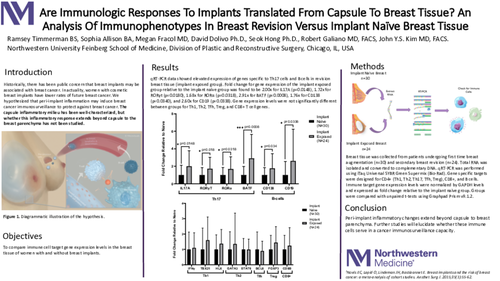
METHODS: Breast tissue was collected from patients undergoing first time breast augmentation (n=30) and secondary breast revision (n=24). Total RNA was isolated and converted to complementary DNA. qRT-PCR was performed using iTaq Universal SYBR Green Supermix (Bio-Rad). Gene specific targets were designed for CD4+ (Th1, Th2, Th17, Tfh, Treg), CD8+, and B cells. Immune target gene expression levels were normalized by GAPDH levels and expressed as fold change relative to the implant naïve group. Groups were compared with unpaired t-tests using Graphpad Prism v9.1.2.
RESULTS: qRT-PCR data showed elevated expression of genes specific to Th17 cells and B cells in revision breast tissue (implant exposed group). Fold change for gene expression of the implant exposed group relative to the implant naïve group was found to be 2.00x for IL17A (p=0.0148), 1.72x for RORγt (p=0.0180), 1.68x for RORα (p=0.0318), 2.91x for BATF (p=0.0008), 1.76x for CD138 (p=0.0340), and 2.60x for CD19 (p=0.0338). Gene expression levels were not significantly different between groups for Th1, Th2, Tfh, Treg, and CD8+ T cell genes.
CONCLUSION: Peri-implant inflammatory changes extend beyond capsule to breast parenchyma. Further studies will elucidate whether these immune cells serve in a cancer immunosurveillance capacity.