171 posters, 10 topics, 5 sessions, 690 authors, 211 institutions
ePostersLive by SciGen Technologies S.A. All rights reserved.
American Association of Plastic Surgeons Meeting 2022
April 9 - 12 | San Diego, California

P20
Can Extent Of Adipose Tissue Washing Impact The Therapeutic Efficacy Of Autologous SVF Cell Therapies?
Poster Presenter
Authors
Affiliations
Part of Topic
Basic Science Research
CAN THE EXTENT OF ADIPOSE TISSUE WASHING IMPACT THE THERAPEUTIC EFFICACY OF STROMAL VASCULAR FRACTION CELL THERAPIES?
INTRODUCTION
Adipose-derived SVF cell therapies have entered Phase 3 FDA testing. A major challenge for point-of-care autologous cell strategies is the inherent variability that exists when using primary cells derived from a variety of patients. SVF is composed of numerous cell types, including mesenchymal stromal cells and blood derived cells (BDCs). Individual patient/donor characteristics, tissue harvest methods, and tissue processing/cell isolation methods all present possible sources of SVF variability, and tissue processing/cell isolation is likely the most easily modifiable.
Cell preparations typically include some degree of erythrocyte (RBC) “contamination.” Most protocols utilize a RBC lysate step, despite the fact that RBC contents are known to be inflammatory. The impact of these steps on cell viability and biological activity remain unclear.
Our central hypothesis is that 1) the extent of adipose tissue washing influences the number of blood derived cells (BDCs) in SVF preparations, and 2) BDCs within SVF preparations confer modifiable effects on SVF bioactivity.
METHODS:
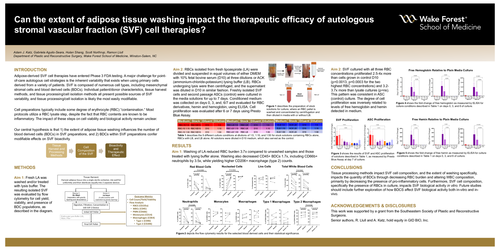
Aim 1: Fresh LA was washed and/or treated with lysis buffer. The resulting isolated SVF was evaluated by flow cytometry for cell yield, viability, and presence of BDC populations.
Aim 2: RBCs isolated from fresh lipoaspirate (LA) were divided and suspended in equal volumes of either DMEM with 10% fetal bovine serum (D10) at three dilutions or ACK (ammonium-chloride-potassium) lysing buffer (LB). RBCs undergoing lysis were then centrifuged, and the supernatant was diluted in D10 in similar fashion. Freshly isolated SVF cells and second passage ASCs (control) were cultured in the media solutions for up to 7 days. Conditioned medium was collected on days 0, 3, and, 6/7 and evaluated for RBC derivatives, hemin and hemoglobin, using ELISA. Cell proliferation was evaluated after 6 or 7 days using Presto Blue Assay.
RESULTS:
Aim 1: Washing of LA reduced RBC burden 3.7x compared to unwashed samples and those treated with lysing buffer alone. Washing also decreased CD45+ BDCs 1.7x, including CD66b+ neutrophils by 3.5x, while yielding higher CD206+ macrophage (type 2) counts.
Aim 2: SVF cultured with all three RBC concentrations proliferated 2.5-4x more than cells grown in control D10 (p=0.0013, p=0.0003 for the two highest RBC concentrations) and 3.2-3.7x more than lysate cultures (p=ns). This pattern was consistent in ASC (control) culture. The degree of cell proliferation was inversely related to levels of free hemoglobin and hemin detected in medium.
CONCLUSIONS
Tissue processing methods impact SVF cell composition, and the extent of washing specifically impacts the quantity of BDCs through decreasing RBC burden and altering WBC composition, primarily by decreasing the presence of pro-inflammatory cells. Furthermore, SVF cell composition, specifically the presence of RBCs in culture, impacts SVF biological activity in vitro. Future studies should include further exploration of how BDCS affect SVF biological activity both in-vitro and in-vivo.