171 posters, 10 topics, 5 sessions, 690 authors, 211 institutions
ePostersLive by SciGen Technologies S.A. All rights reserved.
American Association of Plastic Surgeons Meeting 2022
April 9 - 12 | San Diego, California

P30
Use Of Surgical Epibole For Modeling Chronic Unresolved-inflammation And Granulation In Murine Wounds.
Poster Presenter
Authors
Affiliations
Part of Topic
Basic Science Research
Use of Surgical Epibole for Modeling Chronic Unresolved-inflammation and Granulation in Murine Wounds
Background:
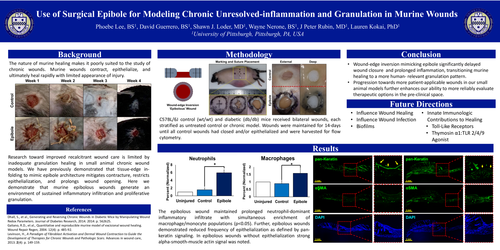
The nature of murine healing makes it poorly suited to the study of chronic wounds. Murine wounds contract, epithelialize, and ultimately heal rapidly with limited appearance of injury. Research toward improved recalcitrant wound care is limited by inadequate granulation healing in small animal chronic wound models. We have previously demonstrated that tissue-edge in- folding to mimic epibole architecture mitigates contracture, restricts epithelialization, and prolongs wound opening. Here we demonstrate that murine epibolous wounds generate an environment of sustained inflammatory infiltration and proliferative granulation.
Methodology:
C57BL/6J control (wt/wt) and diabetic (db/db) mice received bilateral wounds, each stratified as untreated control or chronic model. Wounds were maintained for 14-days until all control wounds had closed and/or epithelialized and were harvested for flow cytometry.
Results:
The epibolous wound maintained prolonged neutrophil-dominant inflammatory infiltrate with simultaneous enrichment of macrophage/monocyte populations (p<0.05). Further, epibolous wounds demonstrated reduced frequency of epithelialization as defined by pan- keratin signaling. In epibolous wounds without epithelialization strong alpha-smooth-muscle actin signal was noted.
Conclusion:
Wound-edge inversion mimicking epibole significantly delayed wound closure and prolonged inflammation, transitioning murine healing to a more human- relevant granulation pattern.
Progression towards more patient-applicable wounds in our small animal models further enhances our ability to more reliably evaluate therapeutic options in the pre-clinical space.