171 posters, 10 topics, 5 sessions, 690 authors, 211 institutions
ePostersLive by SciGen Technologies S.A. All rights reserved.
American Association of Plastic Surgeons Meeting 2022
April 9 - 12 | San Diego, California

P29
Developing A Long-term Survival Hemi-facial Vascularized Composite Allotransplantation Swine Model To Study Facial Nerve Regeneration
Poster Presenter
Authors
Anita Mohan, Marissa Suchyta,, Stacey Bernard, Joanne Pedersen, Lisa Yngsdal, Amy Benike, Basel Sharaf, Karim Bakri, Waleed Gibreel, Hatem Amer, Samir Mardini
Affiliations
Part of Topic
Basic Science Research
Developing A Long-term Survival Swine Hemi-facial Vascularized Composite Allotransplantation Model To Study Facial Nerve Regeneration
PURPOSE: We present a survival large animal model for preclinical facial transplant research to evaluate facial nerve regeneration.
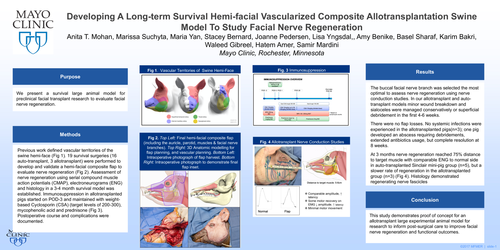
METHODS: 19 survival surgeries (16 auto-transplant, 3 allotransplant) were performed to develop and validate a hemi-facial composite flap to evaluate nerve regeneration (Fig 1). Assessment of nerve regeneration using serial compound muscle action potentials (CMAP), electroneurograms (ENG) and histology in a 3-4 month survival model was established. Immunosuppression in allotransplanted pigs started on POD-3 and maintained with weight-based Cyclosporin (CSA) (target levels of 200-300), mycophenolic acid and prednisone. Postoperative course and complications were documented.
RESULTS: The buccal facial nerve branch was selected the most optimal to assess nerve regeneration using nerve conduction studies. In our allotransplant and auto-transplant models minor wound breakdown and sialoceles were managed conservatively or superficial debridement in the first 4-6 weeks. There were no flap losses. No systemic infections were experienced in the allotransplanted pigs(n=3); one pig developed an abscess requiring debridements, extended antibiotics usage, but complete resolution at 8 weeks. At 3 months nerve regeneration reached 75% distance to target muscle with comparable ENG to normal side in auto-transplanted Sinclair mini-pig group (n=5), but a slower rate of regeneration in the allotransplanted group (n=3).
CONCLUSION: This study demonstrates proof of concept for an allotransplant large experimental animal model for research to inform post-surgical care to improve facial nerve regeneration and functional outcomes.