171 posters, 10 topics, 5 sessions, 690 authors, 211 institutions
ePostersLive by SciGen Technologies S.A. All rights reserved.
American Association of Plastic Surgeons Meeting 2022
April 9 - 12 | San Diego, California

P26
Wound-edge Inversion Results In The Reliable, Mechanical Formation Of Dystrophic Scars In Mice
Poster Presenter
Authors
Affiliations
Part of Topic
Basic Science Research
Wound-edge Inversion Results in the Reliable, Mechanical Formation of Dystrophic Scars in Mice
Background:
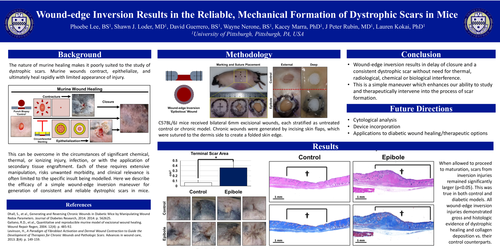
The nature of murine healing makes it poorly suited to the study of dystrophic scars. Murine wounds contract, epithelialize, and ultimately heal rapidly with limited appearance of injury. This can be overcome in the circumstances of significant chemical, thermal, or ionizing injury, infection, or with the application of secondary tissue engraftment. Each of these requires extensive manipulation, risks unwanted morbidity, and clinical relevance is often limited to the specific insult being modelled. Here we describe the efficacy of a simple wound-edge inversion maneuver for generation of consistent and reliable dystrophic scars in mice.
Methodology:
C57BL/6J mice received bilateral 6mm excisional wounds, each stratified as untreated control or chronic model. Chronic wounds were generated by incising skin flaps, which were sutured to the dermis side to create a folded skin edge.
Results:
When allowed to proceed to maturation, scars from inversion injuries remained significantly larger (p<0.05). This was true in both control and diabetic models. All wound-edge inversion injuries demonstrated gross and histologic evidence of dystrophic healing and collagen deposition vs. their control counterparts.
Conclusion:
Wound-edge inversion results in delay of closure and a consistent dystrophic scar without need for thermal, radiological, chemical or biological interference.
This is a simple maneuver which enhances our ability to study and therapeutically intervene into the process of scar formation.